Last reviewed: October 26, 2026
A surgical ICU rotation can feel like somebody changed the rules of residency without warning. On the ward, the resident’s day is usually organized around operations, rounds, consults, discharges, and the problems that appear between them. In the ICU, a single patient can occupy the clinical bandwidth of an entire ward list. The operation may already be over. What matters now is what happens minute by minute afterward.
That shift is uncomfortable for a reason. Surgical training teaches you to identify a problem and move toward a decision. Critical care often asks you to hold several competing problems in your head, intervene selectively, and keep reassessing whether your intervention actually helped. The resident who feels efficient on the surgical floor may suddenly feel slow again.
This is not a story about one ICU or one resident. Units differ enormously in staffing, protocols, scope of practice, and supervision. It is a resident-side map of what tends to change when surgical training moves into critical care—and how to use that rotation for more than surviving the ventilator settings and morning presentations.
The biggest change: you stop thinking in snapshots
On a normal surgical round, it is tempting to think in snapshots: the patient looks well, the abdomen is soft, the drain output is acceptable, the hemoglobin is stable, the plan is advance diet and mobilize. In critical care, the direction of travel often matters as much as the current number.
A blood pressure of 100/60 is not one piece of information. Is it improving or falling? Did the vasopressor requirement change? What happened after fluid, analgesia, sedation, diuresis, a procedure, or a ventilator adjustment? Is urine output moving in the same direction as the circulation? Are lactate, mental status, temperature, gas exchange, and peripheral perfusion telling the same story?
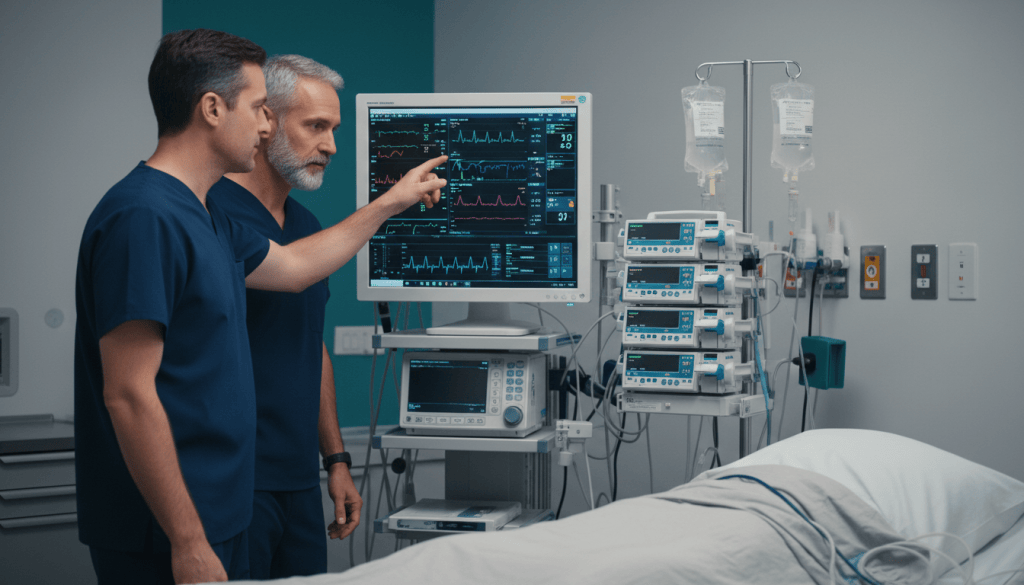
The ICU teaches a form of temporal reasoning: not simply what is abnormal?, but what changed, when did it change, what did we do, and what happened next? That habit transfers back to the surgical ward. It is particularly useful when a postoperative patient begins to deteriorate; our guide to recognizing postoperative deterioration explores that problem in more detail.
Your presentation becomes a clinical argument
Early in the rotation, ICU presentations can become data dumps. There is simply too much information available: overnight events, invasive pressures, ventilator parameters, fluid balance, infusions, laboratory trends, microbiology, imaging, nutrition, lines, drains, prophylaxis, medications, and organ-specific plans.
The answer is not to speak faster. A useful ICU presentation organizes information around the patient’s active physiology and decisions. The listener should understand what the major problems are, whether each is improving or worsening, what support the patient currently needs, and what you want to change today.
A practical mental structure is: overnight change → current support → organ-by-organ trajectory → today’s decisions → what could make the plan fail. That last part matters. “We will reduce support” is less useful than knowing what would make you stop reducing it. “Continue antibiotics” is incomplete if nobody has considered the suspected source, cultures, source control, and when the decision should be revisited.
This is the same discipline behind a concise surgical presentation, but with more moving parts. If organizing a case verbally is still difficult, start with how to present a surgical patient on rounds without rambling.
You learn that “support” is an active treatment
Residents arrive in critical care with different levels of exposure to ventilation, hemodynamic support, renal replacement therapy, sedation, nutrition, and invasive monitoring. It is easy to treat these as a collection of machines and settings to memorize. That approach does not scale.
A better question is what problem each form of support is solving, what harm it can create, and what evidence tells you the patient needs more or less of it. The ventilator is not a row of numbers; it is a way of supporting gas exchange while balancing lung protection, synchrony, sedation, and the underlying disease. A vasopressor is not merely “on” or “off”; its dose and trajectory sit inside a larger assessment of perfusion, volume status, cardiac function, vascular tone, and the reason the circulation failed.
This is also why an ICU rotation should not become an unsupervised attempt to memorize local protocols. Protocols are useful, but the educational goal is understanding the physiology and the unit’s escalation pathways. The exact thresholds and treatment choices belong to the supervising critical-care team and local policy.
The operation is still relevant—but it is no longer the whole story
Surgical residents bring something valuable to the ICU: an understanding of anatomy, operative decisions, drains, wounds, source control, and the complications that follow procedures. But critical care forces you to connect those surgical facts to whole-patient physiology.
A technically successful operation does not make the postoperative course simple. The ICU resident has to keep asking whether the current physiology is expected for this operation and this patient—or whether it represents a new problem. That requires communication with the operating team rather than treating the ICU and OR as separate worlds.
It also changes how you prepare for surgery later. Once you have watched the postoperative consequences of bleeding, fluid shifts, pulmonary complications, infection, organ dysfunction, and prolonged support, “case preparation” becomes more than memorizing the operative steps. Our 15-minute case-prep framework is stronger when you can imagine the postoperative physiology as well as the operation itself.
The emotional difficulty is different from the OR
Operating-room stress is often concentrated: a difficult exposure, bleeding, an unexpected finding, a moment when the plan has to change. ICU stress can be prolonged. A patient may remain critically ill despite appropriate care. Several organ systems can improve and worsen at different speeds. Families may understandably ask for certainty when the team can only offer probabilities and the next reassessment point.
For residents, this can create an uncomfortable feeling of doing a great deal without producing a dramatic “fix.” Learning critical care includes learning that careful reassessment, preventing secondary harm, communicating uncertainty, and recognizing when the trajectory has changed are real clinical work.
It also makes hierarchy and communication visible. When you are worried, you need to say so early and clearly. The article on speaking up in surgical training applies just as strongly in the ICU, where delays in escalation can matter quickly.
What to learn first when everything feels important
The first days can produce a predictable mistake: trying to learn all of critical care at once. Instead, build a hierarchy.
First, learn the unit itself: who is responsible for what, how urgent escalation works, how rounds are structured, where plans are documented, and which decisions require senior review. Second, learn to identify immediate instability and the support already in place. Third, learn the physiology behind the common problems you see repeatedly. Only then does it make sense to chase increasingly specialized details.
For each patient, try to leave rounds able to answer five questions:
- Why is this patient still in intensive care?
- What organ support do they need right now?
- What has objectively changed since yesterday?
- What are we trying to achieve today?
- What finding would make us escalate or change course?
If you can answer those consistently, the rest of the data begins to attach itself to a clinical framework instead of remaining isolated facts.
Procedures are visible; judgment is the harder curriculum
ICU rotations can include procedures, but procedure counts are an incomplete measure of whether the rotation is going well. The more transferable learning is often less visible: recognizing when a patient is tiring, deciding which abnormality deserves attention first, understanding when additional data will change management, anticipating the next problem, and knowing when your uncertainty is itself a reason to call someone senior.
The ACGME’s current General Surgery Program Requirements, effective July 1, 2026, explicitly include surgical critical care within general surgery education, while Surgical Critical Care has its own dedicated fellowship requirements. That formal structure reflects something residents feel in practice: critical care is not peripheral to surgery. It is part of learning to care for surgical patients across the full arc of illness.
Use the rotation to become better after you leave it

The best ICU learning is portable. After a shift, write down one clinical pattern rather than ten disconnected facts. Maybe it is how the team interpreted a trend, why an intervention was stopped, what made somebody escalate, or which piece of information changed the differential. Then look up that question from a reliable source when the shift is over.
Ask for feedback on reasoning, not only performance: “What did I miss in how I framed that patient?” or “What made you worry earlier than I did?” Specific questions are more likely to produce useful teaching than “Any feedback?” The same principle is developed in our guide to getting useful feedback in surgical residency.
And pay attention to handoff. Critically ill patients accumulate contingencies. A safe transfer is not a recitation of the chart; it is a transfer of the mental model—what is happening, what you are watching, and what the next resident should do if the trajectory changes. See the surgical handoff guide for a practical framework.
What the ICU changes in a surgical resident
The point of a surgical ICU rotation is not to turn every resident into an intensivist. It is to make the resident harder to surprise by physiology.
You begin to notice trajectories earlier. You become more suspicious of a reassuring single number when the rest of the patient is moving in the wrong direction. You learn that an intervention is not complete until you check its effect. You get more comfortable saying, “I do not know yet, but this is what I am watching.” And when you return to the ward or operating room, the patient on the other side of the operation looks different because you can better imagine what might happen next.
That is why the rotation can feel like starting over—and why it can become one of the most useful transitions in surgical training.
Sources and Further Reading
- ACGME — Surgery Program Requirements and FAQs, including General Surgery requirements effective July 1, 2026.
- ACGME — Surgical Critical Care Program Requirements, effective July 1, 2026.
- Sachdeva AJ. Simulation to support transitions in the careers of surgical trainees and surgeons. Surgery. 2025.
- Kochis MA, et al. “Stepping Out of a Comfort Zone”: Evaluating the Impact of a Leadership Skills Curriculum on Surgical Residents’ Transition to Senior Roles. Journal of Surgical Education. 2025.




Leave a Reply