The operation may be over when the dressing goes on, but the resident’s work is not. There is still a handoff, postoperative orders, family communication, specimens, and one task that is easy to treat as clerical: the operative note.
That is a mistake. A good operative note is not a transcript of everything that happened. It is a reconstruction of the operation that another clinician can understand later: why the procedure was done, what was found, what was actually performed, what changed from the expected plan, and what matters for the patient’s care afterward.
For residents, learning to write that note is also a surprisingly useful test of whether the operation made sense in your own head.

Why dictating a case exposes what you did not understand
In the operating room, you can follow a sequence without fully owning it. The attending asks for an instrument, changes the angle, takes over a difficult portion, or moves the operation forward. You may understand each individual action while it is happening but still have a fuzzy model of the case as a whole.
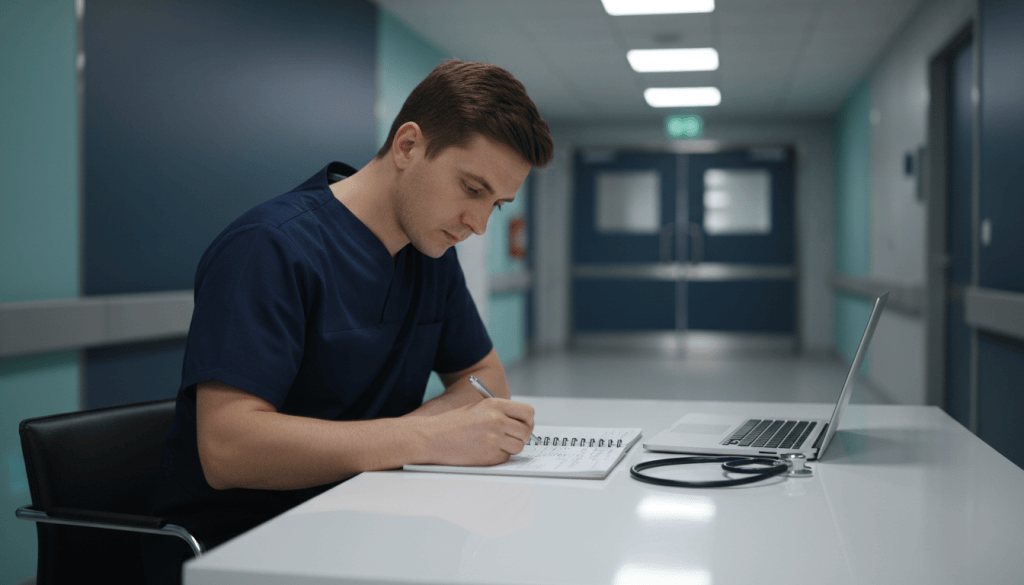
Then you sit down to document it.
Suddenly the gaps become obvious. What exactly was the indication? What exposure was obtained first? Which structure was identified before the next step? What was divided, preserved, mobilized or reconstructed? Why did the operation deviate from the expected sequence? Which finding actually mattered?
If you cannot describe the operation coherently afterward, that does not automatically mean you performed badly. It does tell you where your mental model is incomplete. That makes the operative note more than documentation: used deliberately, it becomes a short post-case learning exercise.
A note should answer the questions the next clinician will have
Templates vary by hospital, specialty and country, so residents should follow local documentation requirements. But the useful core is remarkably consistent. A reader should be able to determine the indication, procedure, important findings, operative sequence, relevant specimens or devices, complications or unexpected events, and the immediate disposition.
The key word is relevant. More words do not automatically create a better note.
A note that reproduces generic textbook steps but barely describes the unusual anatomy is less useful than a concise note that makes the important finding clear. Likewise, a copied template that says a structure was normal when nobody actually assessed it creates false certainty. Documentation should describe the case that happened, not the case the template expected.
The resident mistake: starting with prose instead of reconstructing the case
When a resident is tired and several tasks are waiting, the temptation is to open the template and start typing. That often produces a note that is technically complete but difficult to follow.
A better approach is to reconstruct the operation in your head before writing sentences. Think through a simple chain:
- Why were we operating?
- What did we find?
- What were the major phases of the operation?
- Where did reality differ from the expected plan?
- What information will matter tonight, tomorrow, or at a future reoperation?
This is the postoperative mirror image of preparing a case before the operation. Before surgery, you predict the sequence. After surgery, you reconstruct the sequence that actually occurred. Comparing those two versions is where a lot of learning lives.
The parts worth slowing down for
1. The indication
The indication is not merely the diagnosis. It explains why this operation was appropriate now. That distinction matters. Two patients can have the same diagnosis but undergo different procedures because the clinical context, urgency, prior treatment, anatomy or operative goal differs.
2. The findings
This is often the most valuable part of the note for somebody who was not in the room. Record what materially affected the procedure or future care. Avoid turning the findings section into a second copy of the technique.
3. The operative sequence
A reader should be able to follow the major progression of the case. This does not require documenting every hand movement. It requires enough anatomical and procedural logic to explain how the operation moved from access to the completed procedure.
4. Deviations and difficult moments
These are exactly the details that generic templates handle badly. If the plan changed, anatomy was unusual, an additional procedure became necessary, or an intraoperative issue affected postoperative management, the note should make that understandable. When unsure about wording or what must be included, ask the supervising surgeon rather than guessing.
5. What the next team needs to know
Documentation and handoff are different jobs, but they should agree. If a drain, device, reconstruction, specimen, postoperative restriction, planned study or specific concern matters to the next team, the operative record should not contradict the verbal plan. The same discipline that makes a useful surgical handoff makes a useful operative note: prioritize information that changes what somebody does next.
Do not turn the note into a memory test
Residents sometimes delay documentation because they want to finish ward jobs first. The longer the delay, the easier it is for small but important details to blur together—especially on a day with multiple cases.
Document promptly according to local policy. If you are uncertain about a detail, verify it. Review the available record, clarify with the operating surgeon, and make sure the final note accurately reflects the case. Never fill a gap with what “usually” happens in that operation.
This becomes more important as autonomy grows. A resident who is increasingly trusted to perform parts of an operation also needs to become increasingly reliable at explaining what happened. Operative responsibility and documentation responsibility develop together.
Case logs are not the same thing as operative notes
In U.S. ACGME-accredited general surgery programs, residents must document their operative experience in the ACGME Case Log System. The requirements effective July 1, 2026 state that operative experience must have sufficient volume and variety, and the specialty background section specifies a minimum of 850 major cases, including experience benchmarks before PGY-3, as teaching assistant, and during chief residency. The ACGME also emphasizes graduated responsibility based on competency—not case numbers alone.
That distinction matters. A case log records that an experience occurred. The operative note records what happened to a particular patient. Neither is a substitute for the other, and accumulating numbers is not the same as understanding operations.
For residents outside the United States, logging systems and requirements differ. The practical lesson still travels well: keep required training records current, but do not confuse administrative completion with educational reflection.
Use the note to generate one learning question
You do not need a thirty-minute reflection after every operation. Residency does not usually provide that kind of time.
Instead, when the note exposes a gap, capture one question. Why did we choose that plane? What landmark made the attending change direction? Why was one reconstruction preferred over another? Which finding changed the postoperative plan?
That question is much more valuable than vaguely promising yourself to “read more.” It gives you something specific to review before the next similar case. It also gives you a better question to ask when you seek useful feedback from a senior surgeon.

Operative notes are a teachable skill—and often an under-taught one
A published needs assessment of surgical trainees found limited formal experience and feedback around operative dictation: among participating residents, 77% reported receiving minimal feedback on their operative dictations. The study concluded that formal training could strengthen this part of surgical education.
That fits a broader reality of residency. Some skills are taught explicitly. Others are learned because somebody eventually tells you that your note is too vague, your presentation is too long, or your handoff buried the important problem. Residents progress faster when these supposedly “small” skills are treated as clinical skills worth teaching.
If you are junior, ask a senior resident or attending to review one of your notes—not every note, just one. Ask what they would remove, what they would add, and which details they expect to see immediately. That single review can improve the next fifty dictations.
A simple post-case routine
After the operation, the resident’s workflow can be reduced to a few questions:
- Can I explain why we operated?
- Can I reconstruct the major steps without a template prompting me?
- What finding or deviation would matter to someone who was not there?
- Does the documented plan agree with the handoff and postoperative orders?
- What is the one thing from this case I need to understand better before I see it again?
The point is not to make every operative note beautiful. It is to make it accurate, clinically useful, and honest—and to notice when writing it reveals that your understanding is incomplete.
Surgical residency is full of these hidden learning moments. The operation teaches you while you are scrubbed. The debrief teaches you afterward. And sometimes the blank operative-note field teaches you exactly what you did not yet know.
Last reviewed: October 26, 2026
Sources and Further Reading
- ACGME Program Requirements for Graduate Medical Education in General Surgery, effective July 1, 2026.
- ACGME Surgery: Case Log Information.
- ACGME Answers: A Look at Case Log Minimums.
- Operative dictations in surgical trainees: an underutilized educational resource?
- Whiteboard Time Out (WBTO) Improves Resident Operative Performance, Journal of Surgical Education.




Leave a Reply