Last reviewed: October 2026.
A surgical handoff is not a compressed ward round and it is not a recital of the chart. It is a transfer of responsibility. The resident receiving the list needs to understand what could happen next, which patients are unstable, what must be checked, and when the plan should change.
That sounds obvious. In practice, handoff happens at exactly the wrong time for perfect communication: one team is tired and wants to leave, the next is trying to build a mental model of an entire service in minutes, pages are arriving, operations may still be running, and the patient list is rarely as clean as anyone would like.
For a surgical resident, learning to hand over well is therefore less about speaking beautifully and more about transferring risk without burying it.
The real job of handoff: transfer the mental model
A weak handoff transfers facts. A useful handoff transfers a model of the patient.
“Post-op day two after colectomy, stable, labs tomorrow” gives the receiving resident almost nothing to work with. What matters is why the patient still needs attention: Is the tachycardia improving? Has the patient passed flatus? Is there a drain with output that needs to be watched? Was there a difficult intraoperative finding? Is there a threshold at which the senior surgeon wants to be called?
The receiver should be able to answer four questions after you finish: Who is this patient? What is happening now? What could go wrong before morning? What do I need to do about it?

Do not give every patient equal airtime
One of the first handoff mistakes residents make is treating the list democratically. Ten uncomplicated patients receive ten equally detailed presentations, while the one patient with a meaningful overnight risk gets lost in the same rhythm.
Good handoff is deliberately uneven. Stable patients can often be transferred quickly. High-risk patients deserve more context, explicit contingencies, and confirmation that the receiver understood the plan.
A useful way to sort the list mentally is: watch closely, active tasks, and background awareness. A patient with evolving physiology belongs in the first group. A stable patient waiting for a scheduled laboratory result belongs in the second. A patient with an uncomplicated course and no expected overnight action belongs in the third.
This is not a formal universal classification. It is a practical way to stop low-risk information from consuming the attention needed for higher-risk patients.
Start with the one-line surgical identity
The first sentence should orient the listener. Include the surgical problem, relevant procedure, postoperative day when useful, and the issue that currently matters.
For example, the useful structure is not a full history. It is closer to: patient with the relevant diagnosis, after the relevant operation, now being watched for the relevant problem. The exact wording changes by service, but the principle is stable: establish context before details.
This differs from a formal presentation on rounds. If you want the fuller framework for daytime presentations, see How to Present a Surgical Patient on Rounds Without Rambling. Handoff has a narrower goal: make the next hours safer.
Then say what changed
Static data are often less useful than trajectory. A heart rate of 105 means something different if it has fallen from 125 after treatment than if it has climbed from 80 over three hours. The same is true for urine output, oxygen requirement, pain, drain output, abdominal findings, inflammatory markers, hemoglobin, and mental status.
When something is moving in the wrong direction, say that explicitly. Do not make the receiver reconstruct the trend from scattered numbers.
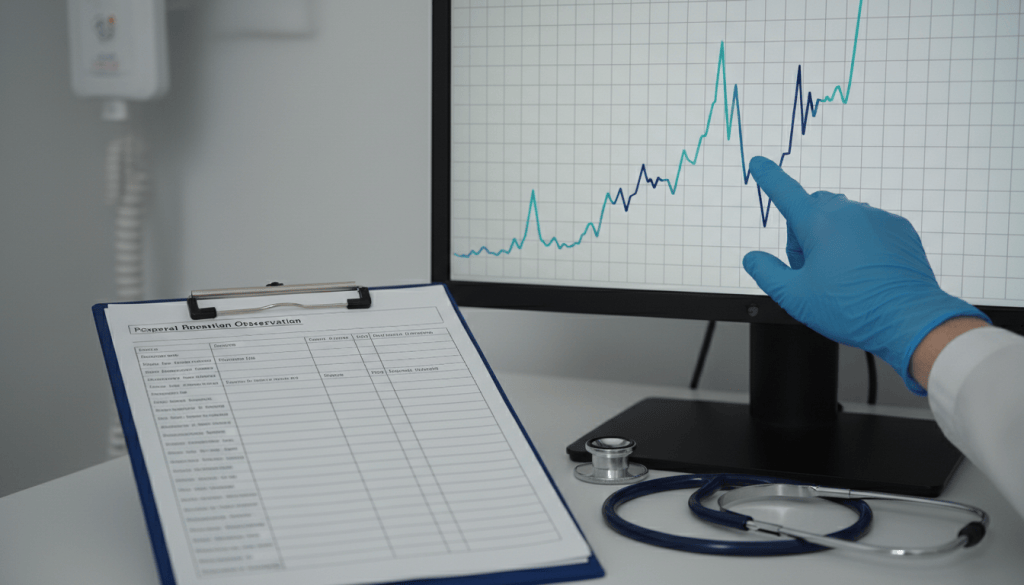
This is especially important after surgery, where deterioration can initially be subtle. The related guide The Postoperative Patient Is Getting Worse goes deeper into reading postoperative trajectory rather than relying on isolated values.
A task without a contingency is only half a handoff
“Check the hemoglobin at midnight” is a task. It is not yet a plan.
The receiver also needs to know what result matters and what should happen if the result is abnormal. That does not mean inventing rigid thresholds when none exist. It means passing on the decision logic that has already been agreed with the team.
Whenever possible, hand over tasks as action + reason + response: what needs to be done, why it matters, and what the next step is if the expected result does not occur.
This is where vague handoffs become dangerous. “Keep an eye on him” sounds cautious but gives no usable instruction. What exactly should be watched? What change would concern you? Who should be contacted? What has already been discussed with the senior?
Say what you are worried about
Residents sometimes soften uncertainty because they do not want to sound alarmist. Handoff is not the place to hide concern behind neutral language.
If a patient worries you, say so and explain why. “The numbers are not terrible, but the trajectory concerns me because…” is often more useful than a confident-sounding summary that leaves out your clinical impression.
Clinical concern is not a diagnosis. It is information. The incoming resident can reassess the patient with fresh eyes, but only if they know where the uncertainty lies.
Make escalation part of the plan
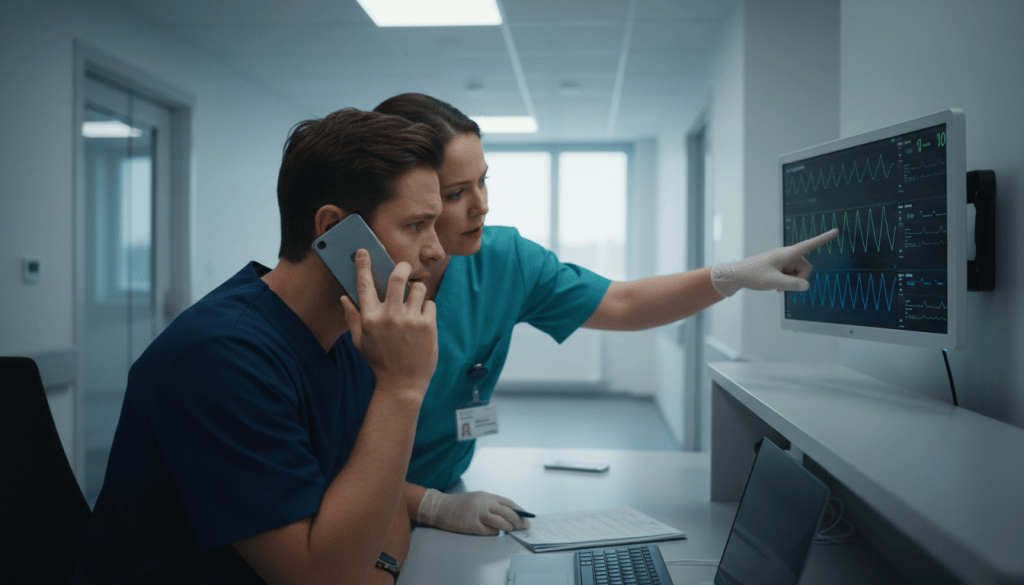
A safe handoff includes the escalation pathway. The resident covering overnight should know which developments require senior review rather than being left to infer the threshold alone.
Current ACGME requirements continue to treat structured handover and competence in handoff communication as patient-safety responsibilities. The broader principle applies well beyond the United States: continuity of care depends on the team deliberately transferring responsibility rather than assuming the next clinician will reconstruct the plan from the record.
Closed-loop communication matters most on the sick patients
For a high-risk patient, do not assume silence means understanding. Give the receiver space to ask questions. If the plan is complex, a brief read-back or summary can expose a misunderstanding before it reaches the bedside.
This does not require turning every handoff into a ceremony. It means slowing down for the patients where misunderstanding would matter most.
What should be written down?
The written list should support the verbal handoff, not compete with it. It should make active tasks and high-risk information easy to find. Long copied histories, stale medications, and paragraphs imported from previous notes can create the illusion of completeness while making the important information harder to see.
Local systems differ, and residents should follow their institution’s approved handoff tools and privacy rules. Whatever the platform, the list needs to be current. A beautifully formatted handoff with yesterday’s plan is worse than a plain one that reflects what is actually happening.
Handoff gets harder when you are tired
The end of a long shift creates a predictable conflict: the outgoing resident has the most context but the least energy to explain it. This is one reason handoff should be treated as part of clinical work rather than an administrative afterthought.
Do not wait until the final minute to discover that the list is outdated. Update important changes during the shift when possible. Before handoff, identify the sickest patients and unfinished tasks first. If you are exhausted, structure becomes more—not less—important.
For the broader overnight workflow, see How to Prepare for a Surgical Night Shift.
The receiver also has responsibilities
Handoff quality is not solely the outgoing resident’s job. The receiver should actively build a mental model, clarify ambiguity, identify missing contingencies, and verify high-risk information when necessary.
If you do not understand why a patient is being watched, ask. If a task has no clear response plan, ask. If the outgoing resident says a patient “just doesn’t look right,” do not dismiss that because the latest vital signs happen to fit inside a normal range.
A five-part resident handoff
When the service is busy, a compact structure helps. For each patient who needs meaningful handoff, think:
- Identity: What operation/problem defines this admission?
- Now: What is the current state and recent trajectory?
- Risk: What could realistically go wrong before the next team returns?
- Tasks: What must be checked or done, and by when?
- Contingency: What should happen if the patient deviates from the expected course, and when should a senior be called?
This is not a replacement for a locally mandated handoff framework. It is a resident-level mental check that helps prevent the most important information from disappearing inside the list.
The handoff test
A good handoff does not prove that you know everything about your patients. It allows another clinician to care for them safely when you are no longer there.
Before you leave, ask one question: If this patient changes at 2 a.m., have I given the covering resident enough context to recognize why it matters and what to do next?
That is the standard. Not completeness. Usability.
Keep reading: For the wider resident workflow, start with What Is Surgical Residency Really Like? and A Day in the Life of a Surgical Resident.
Sources and Further Reading
- ACGME Common Program Requirements — requirements effective July 1, 2026.
- ACGME: Clinical Responsibilities, Teamwork, and Transitions of Care.
- Patient safety in surgical residency training: systematic review and meta-analysis (2026).
- Learner handover in surgical and procedural training: continuity of coaching or reputational contamination? (2026).





Leave a Reply