
Last reviewed: October 26, 2026
A surgical resident can spend an entire day working hard and still reach the evening with the strange feeling that almost nothing was finished in one uninterrupted stretch.
You start a discharge summary. A nurse calls about urine output. You reopen the chart. The emergency department wants a consult. Your senior asks whether the CT is back. The operating room calls about the next patient. You return to the discharge summary and have to reconstruct where you were.
This is not a dramatic exception to surgical training. It is one of the basic shapes of the job.
The difficult part is that residents are not simply learning surgery while interruptions happen around them. They are learning how to remain clinically reliable inside an interrupted system.
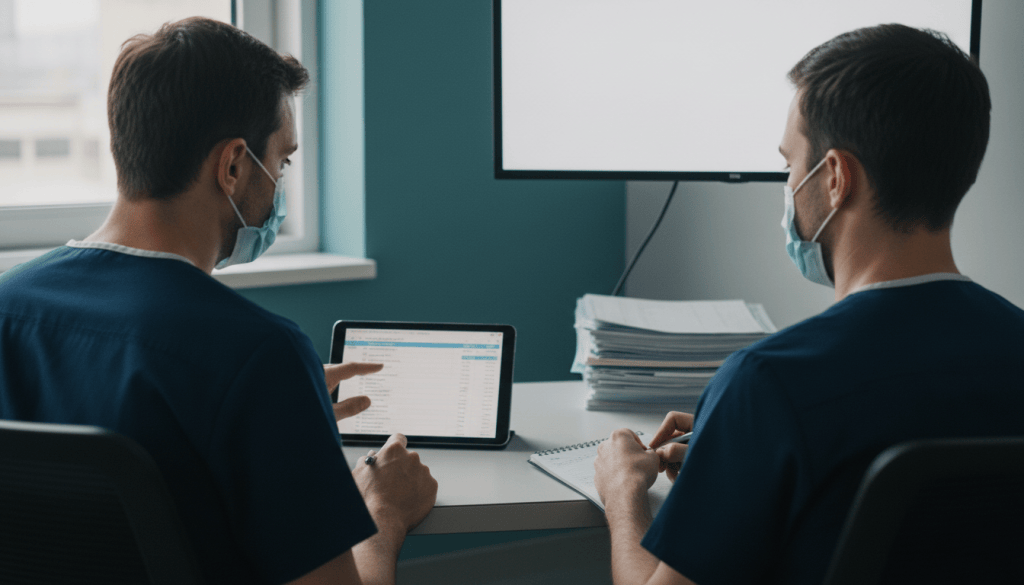
The job is not one task after another
Medical school often presents work as a sequence. See the patient. Take the history. Examine them. Form a differential. Make a plan.
Residency is much less polite.
On a surgical service, several timelines exist at once. A patient is waiting for discharge. Another needs a decision about feeding. A postoperative patient has become tachycardic. The OR schedule is moving. A family wants an update. A consult is waiting in the emergency department. Pathology has resulted on someone you saw days ago.
None of those jobs knows that you are already doing another one.
That is why a resident’s workload cannot be understood by counting only operations or patients. A large part of the cognitive work is maintaining a live model of many unfinished processes: what has happened, what is waiting, what can wait, and what has suddenly become more important.
Interruptions are not automatically bad
Some interruptions are exactly what should happen.
If a nurse notices a meaningful change in a postoperative patient, you want that information to interrupt lower-priority work. If radiology calls with a critical finding, the interruption is clinically useful. If the OR needs a decision that determines whether a case can proceed safely, answering matters.
The goal is therefore not to become impossible to interrupt. Surgery depends on communication and coordination. Current ACGME General Surgery requirements explicitly include effective communication with other health professionals, coordination of care, patient-safety work, and functioning within health care systems.
The problem is that every switch has a cost. You have to stop one mental model, load another, decide what to do, and later recover the original task. The more complex the work, the more expensive that switching can feel.
A time-motion study of junior general surgery residents observed 229 interruptions over 278.2 hours. Interruptions consumed an average of almost an hour of the resident day, and feedback, coaching and informal teaching were disproportionately vulnerable to disruptive interruptions. That matters because the casualty is not only efficiency. Sometimes the thing being displaced is the education residents came to training for.
The hidden skill: preserving the thread
Experienced residents often look faster than junior residents even when they are not physically moving faster. One reason is that they get better at preserving the thread of unfinished work.
Before switching tasks, they leave themselves a restart point.
That restart point can be extremely small: “discharge done except medication reconciliation,” “CT reviewed; need senior decision,” “labs ordered; recheck Hb at 14:00,” or “family called once; try again after rounds.” The exact system varies by hospital and by resident. The principle is more important than the format: do not rely on working memory to hold every open loop.
This is closely related to a good surgical handoff. A handoff externalizes unfinished work for another person. A task system externalizes unfinished work for your future self.
Not every interruption deserves the same response
One of the biggest changes in residency is learning that “someone asked me something” and “this needs to happen now” are not the same sentence.
A useful mental triage is:
- Act now: possible clinical deterioration, time-critical treatment, a safety problem, or something that will immediately change patient flow or an operation.
- Clarify now, do soon: the request matters, but a short delay is safe. Establish exactly what is needed and capture it.
- Batch: routine prescriptions, non-urgent forms, administrative questions, stable updates, and other work that becomes more efficient when grouped.
- Redirect: the request belongs to another person or service, or the caller needs information rather than a new surgical decision.
This is not a rigid clinical rule, and urgency always depends on context. It is a way to resist treating the pager, phone or newest message as an automatic priority system.
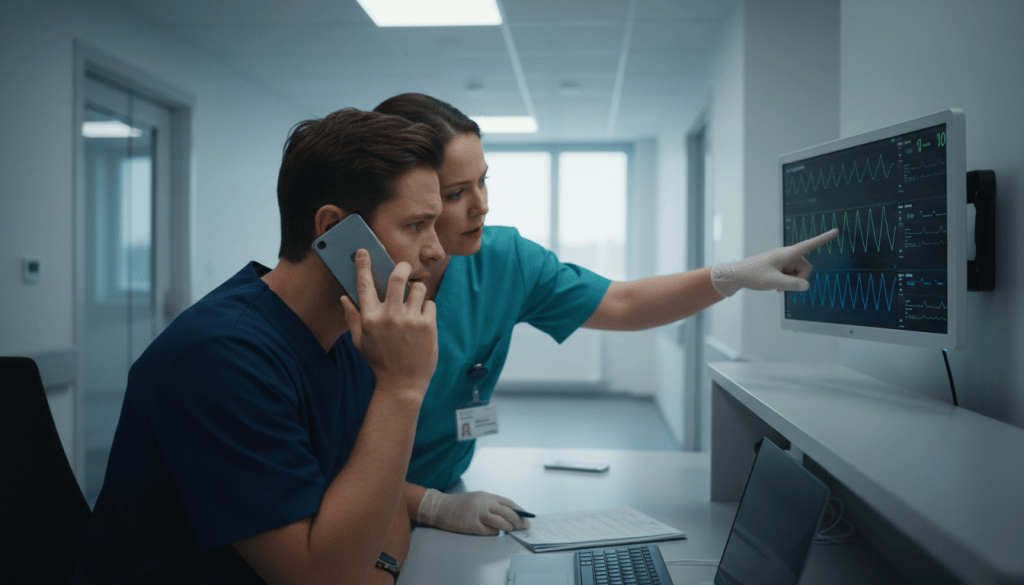
Urgency is a clinical judgment, not a notification sound
Junior residents understandably react quickly to almost everything. You do not yet know which problems are routine, which can safely wait, or which apparently small detail is the beginning of something serious.
That caution is not stupidity. It is what limited pattern recognition feels like.
With experience, the resident starts attaching different weights to information. “Pain” becomes less useful than new severe pain plus tachycardia plus a changing abdominal examination. “Low urine output” becomes a question about trend, volume status, physiology and the operation rather than a number that automatically triggers one response.
This is why learning to recognize postoperative deterioration changes workflow as well as clinical knowledge. Better judgment lets you reorder the day when the patient requires it.
The interruption that should not be squeezed in
Some tasks become unsafe when treated as filler between calls.
Medication decisions, consent discussions, complex discharge reconciliation, reviewing unexpected imaging, communicating a major change in plan, and assessing a deteriorating patient deserve enough attention to understand what you are doing. The exact protected tasks will differ by service, but the resident needs to recognize when fragmentation itself has become a risk.
Sometimes the correct response to a non-urgent interruption is simply: “I’m in the middle of something important. Can I call you back in ten minutes?”
That sentence can feel surprisingly difficult early in training. It requires confidence that protecting attention is not the same as being unhelpful.
Why teaching disappears first
Clinical work has deadlines. Education often does not.
If the ward is busy, the five-minute discussion after an operation is easy to postpone. The feedback conversation gets shortened. The CT teaching point becomes “we’ll look later.” Later may never arrive.
This is one reason residents sometimes have to make learning deliberately visible. Ask one specific question while the case is still fresh. Request one piece of useful feedback rather than waiting for a perfect debrief. Write down the imaging finding you did not understand and return to it when the service settles.
Formalizing a small educational moment may sound less ideal than spontaneous bedside teaching, but it is more likely to survive a day built around interruptions.
The OR has interruptions too — but they feel different
The operating room can be cognitively demanding even when the resident has only one patient in front of them. A 2025 systematic review in Annals of Surgery describes cognitive workload as an important dimension of surgical performance, and newer experimental work continues to show that task complexity and split attention affect mental demand.
For a resident, this helps explain a familiar contrast: the ward can feel difficult because attention is repeatedly divided across patients, while the OR can feel difficult because enormous attention is concentrated on one evolving task.
Neither environment is “easier.” They stress attention differently.
Good preoperative case preparation reduces some avoidable cognitive work by letting anatomy, sequence and danger points become familiar before the operation starts.

A practical system for an interrupted day
You do not need an elaborate productivity method. In fact, a complicated system can become another task to maintain.
A resident-facing system needs only a few properties.
- One trusted capture point. Do not scatter tasks across memory, loose paper, several apps and messages.
- A visible “must happen today” layer. Separate discharge paperwork from a repeat hemoglobin that determines whether a patient needs reassessment.
- Time anchors. Anything that must be revisited at a specific time needs a trigger rather than hope.
- A restart note. When interrupted during complex work, leave enough information to resume without rebuilding the entire thought process.
- A deliberate reset. After rounds, after the OR, and before handoff, stop briefly and rebuild the list. What changed? What is still open? What can now be closed?
The goal is not inbox zero. The goal is clinical reliability.
What senior residents seem to know
Senior residents are interrupted too. Their phones still ring. The consults still arrive. The OR still changes. The difference is that more of the prioritization has become automatic.
They are more likely to know which detail matters, which question can be answered in thirty seconds, which request needs a bedside review, which task can be delegated, and which new information should make them abandon the current plan entirely.
That is part of what progressive responsibility actually looks like from inside training. It is not only being allowed to do more of an operation. It is becoming capable of holding a larger, messier clinical picture without losing the important pieces.
If the first months of training feel fragmented, that does not mean nothing is being learned. As discussed in the first month of surgical residency, learning the workflow is itself part of becoming a resident.
The real endpoint is not perfect focus
Surgical residency will probably never give you a perfectly ordered workday. The service is responsive by design. Patients change. Operations run long. Emergencies arrive. Other teams need decisions.
The skill is not eliminating interruption. It is learning to distinguish signal from noise, preserve unfinished work, protect attention when it matters, and switch priorities without dropping the patient you were responsible for five minutes ago.
That is not productivity advice dressed up as medicine. It is part of the clinical craft of residency.
Sources and Further Reading
- ACGME Program Requirements for Graduate Medical Education in General Surgery, effective July 1, 2026.
- Learning Interrupted: Educational Impact of Interruptions on Surgical Residents, Journal of Surgical Education.
- Objective Assessment of Cognitive Workload in Surgery: A Systematic Review, Annals of Surgery, 2025.
- An Experimental Investigation of the Split-Attention Effect on Endoscopic Surgical Performance, 2025.
- Evaluating Intraoperative Distractions During Surgical Procedures in a University Surgical Department, 2025.





Leave a Reply