
Surgical residency does not only take hours. It makes time unreliable.
That distinction matters. A person can tolerate a busy week when the boundaries are clear. Residency is harder because the end of the day can move, a free evening can disappear, a weekend can contain call, and even when you are physically home your attention may still be partly attached to the hospital.
This is one of the less visible parts of training. The challenge is not simply “work-life balance.” It is learning how to maintain relationships, routines and a sense of self while working inside a system where clinical responsibility is not always predictable.
This is not a first-person account and it is not an argument that every surgical program or every resident experiences training in the same way. It is a resident-side look at a recurring problem in surgical training: what happens to ordinary life when your calendar stops being fully yours.
The problem is not only that residency is busy
Long hours are obvious. Uncertainty is easier to underestimate.
You may know that you are scheduled to work Tuesday. What you may not know with the same confidence is whether you will leave at the expected time, whether an operation will run late, whether the ward will become complicated just before handoff, or whether you will have enough energy afterward to do what you planned.
That changes how people outside medicine experience your schedule. “I finish at six” can quietly mean “six if the list is done, the cases are finished, nobody is deteriorating and the handoff is clean.” To another resident, that sentence requires no explanation. To a friend or partner, repeated uncertainty can feel like unreliability even when nobody is behaving carelessly.
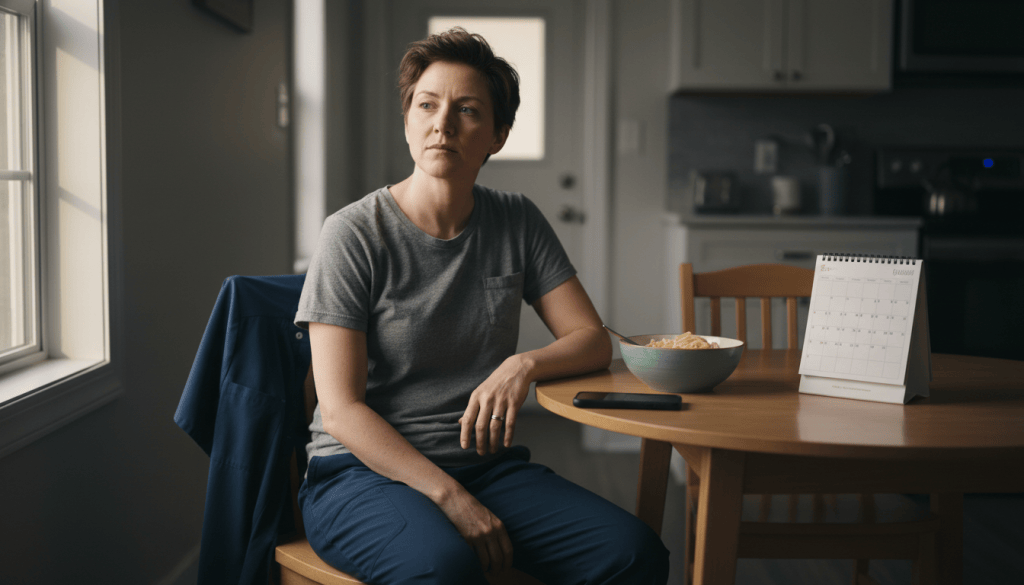
Leaving the hospital is not always the same as being off
There is also a cognitive transition that does not appear on a rota.
A surgical day can involve rapid decisions, unfinished tasks, complications, unfamiliar anatomy, conversations with families, pages, interruptions and the constant need to remember what still has to happen. When the shift ends, the brain does not necessarily switch modes at the hospital door.
Residents may replay a case, wonder whether they communicated something clearly, think about tomorrow’s operating list, check whether they prepared enough, or simply remain mentally accelerated after spending hours reacting to clinical demands. None of that requires a dramatic event. It is part of moving from a high-attention environment back into ordinary life.
This is why protecting life outside the hospital is not just a matter of finding empty squares on a calendar. The useful question is often: when I am technically free, how much of me is actually available?
The calendar starts to develop two kinds of plans
One practical adaptation is to stop treating every plan as if it has the same level of certainty.
Some plans are genuinely protected: annual leave, a post-call period when you should be recovering, or a day you know you are not covering the service. Others are conditional: dinner after a normal workday, the gym after an operating list, or meeting somebody on an evening when you might leave late.
Being explicit about that difference can reduce frustration. “I want to come, but this is a workday and I may be late” is often more useful than confidently promising a time you do not control. It is not romantic, but it is honest.
The same principle applies to residents themselves. If every free evening is packed with an ambitious plan, the first late case can make the entire week feel like a failure. A schedule that assumes residency will behave perfectly is usually a fragile schedule.
Do not make the people in your life decode residency
People outside surgery should not need to understand the difference between an emergency laparotomy, a delayed elective list and a difficult ward handoff to know whether you are likely to be home.
Translate the hospital into normal language. Instead of “I’m on the late shift with possible theatre cover,” the useful information may be: “I probably cannot make a fixed dinner time tonight.” Instead of sending nothing for six hours because the day exploded, a short message when appropriate can prevent uncertainty from becoming personal.
This does not mean texting through clinical work or allowing personal communication to interfere with patient care. It means recognizing that unpredictability has a second audience. The hospital knows why you are late. The person waiting for you may not.
Protect a few things instead of trying to protect everything
Residency can make people respond to scarcity by trying to optimize every free hour: study, exercise, cook, see friends, call family, do administration, prepare tomorrow’s cases and somehow recover at the same time.
That can turn life outside work into another task list.
A more durable approach is to decide which non-work anchors matter most in the current rotation. That might be one evening meal without the phone, a weekly call home, one exercise session that is treated as real rather than optional, or a recurring block of time with a partner or friend. The point is not the specific activity. The point is that something outside the hospital remains predictable.
Recent surgical-education research supports the importance of this social side of training. A 2025 study across four general surgery programs found that more frequent social interaction was associated with stronger perceived social support, and perceived support was closely related to belonging. A nationwide 2025 study of general surgery residents likewise examined belonging as a meaningful feature of the training environment. These studies do not prove that scheduling coffee fixes residency. They do reinforce a more modest point: relationships and belonging are not decorative extras around surgical training.

A day off does not have to become a productivity contest
Residents can become so accustomed to measuring themselves that free time gets measured too.
Did you study enough? Exercise enough? Meal-prep enough? See enough people? Prepare enough for Monday?
There is a difference between using time intentionally and requiring every hour to justify itself. Recovery is not wasted time simply because it produces nothing visible. The post-call day makes this especially obvious, but the same idea applies to ordinary time off.
If the week has been dominated by people needing something from you, an unstructured afternoon may be exactly what allows the next week to feel manageable.
Relationships are affected by patterns, not one missed dinner
Surgical training can interfere with relationships, but the useful conversation is more nuanced than “surgery ruins your personal life.” Recent research involving surgeons, trainees and partners describes long hours, unpredictable schedules and work-related stress as recurring pressures. At the same time, studies also describe the importance of deliberate communication, social support and maintaining priorities outside work.
That distinction matters because residents cannot control every late case. They can influence the pattern around it: whether they communicate, whether every free moment is automatically surrendered to work, whether important people only receive the exhausted leftovers of the week, and whether they notice when a rotation has made ordinary connection disappear.
For residents in relationships, predictability may sometimes matter more than quantity. A reliably protected hour can be more useful than repeatedly promising an entire evening that clinical work may take away.
Residency can quietly become your whole identity
This is perhaps the deeper issue.
Surgery provides an unusually strong identity. You are learning a difficult craft. Your decisions matter. Your colleagues understand a world that can be hard to explain outside the hospital. Progress is visible: first call, first operation, more responsibility, more autonomy.
That can be meaningful. It can also make everything else feel secondary.
The goal is not to pretend surgery is just a job. For many people it becomes an important part of who they are. The goal is to leave enough room for identities that are not evaluated by a consultant, measured in cases, or listed in a portfolio.
A 2025 qualitative study of practicing surgeons found that many described the relationship between work and personal life as integration or negotiation rather than a clean “balance.” Surgeons reporting high satisfaction described being deliberate about personal and professional priorities. That finding is not a prescription for residents, but it captures something useful: a sustainable surgical life is unlikely to appear automatically when training gets less busy. Priorities usually have to be made visible before the calendar fills itself.
What this looks like in practice
A realistic resident approach can be surprisingly simple:
- Know which plans are protected and which are conditional.
- Give people realistic windows instead of optimistic finishing times.
- Keep at least one or two recurring non-work anchors.
- Do not automatically convert every day off into study and administration.
- When you are home, create small periods in which you are actually home.
- Notice when several weeks pass without meaningful contact with people outside work.
- Use leave for life, not only for recovering enough to return to work.
None of this makes residency predictable. It simply stops unpredictability from owning every part of the week.
The resident-side reality
The difficult part of surgical residency is not that residents temporarily have less free time. Most people entering surgery expect that.
The harder adjustment is realizing that time outside the hospital needs active protection because the hospital is exceptionally good at expanding into whatever space is available.
Learning to operate matters. Learning to recognize deterioration matters. Learning to give a clean handoff, prepare for a case, and survive a night shift all matter.
But residency is also several years of your actual life. The aim is not to create a perfect balance that surgery never disturbs. It is to make sure that, while becoming a surgeon, there is still a life for that surgeon to return to.
Last reviewed: October 2026
Sources and Further Reading
- Chen JH, Keyes SA, DeGregorio V, Gardner AK. Enhancing Perceptions of Social Support and Belonging in Surgery Residency Programs. Journal of Surgical Education. 2025.
- Acker RC, Barry C, Sharpe JE, Kelz RR. Belonging in Surgical Residency: A Nationwide Cohort Study. Annals of Surgery Open. 2025.
- Radulovacki K, Ig-Izevbekhai K, Thota HB, Antiel RM. Work, Life, and Meaning in Surgical Practice. Journal of Surgical Research. 2025.
- Fitzgerald JE, Arbaugh CJ, Smith BP, Kopecky KE. Beyond the Scalpel: Supporting Healthy Romantic Relationships in Surgical Life. American Journal of Surgery. 2026.





Leave a Reply