Last reviewed: October 27, 2026.
There is a point in surgical residency when the questions begin to change. Early on, much of the day is about finding the right answer: What are the labs? Has the scan been reviewed? What does the attending want? Later, people start asking a different kind of question: What do you think we should do?
That shift is easy to underestimate. Becoming a senior surgical resident is not simply being a junior resident with more operations behind you. The job becomes less about completing your own tasks and more about holding the service together: seeing the whole patient list, anticipating what can go wrong, deciding what needs senior attention, helping juniors work safely, and knowing when your own judgment has reached its limit.
The transition is rarely clean. Responsibility often arrives before confidence does.
Seniority changes what you are responsible for noticing
A junior resident can have an excellent day by doing assigned work reliably. A senior resident is increasingly judged by what was never explicitly assigned.
Which postoperative patient is quietly drifting in the wrong direction? Which discharge is going to fail because one unresolved issue has been ignored? Which junior is overwhelmed but not saying so? Which case tomorrow needs a plan clarified tonight? Which consultant recommendation changes what the team should do now?
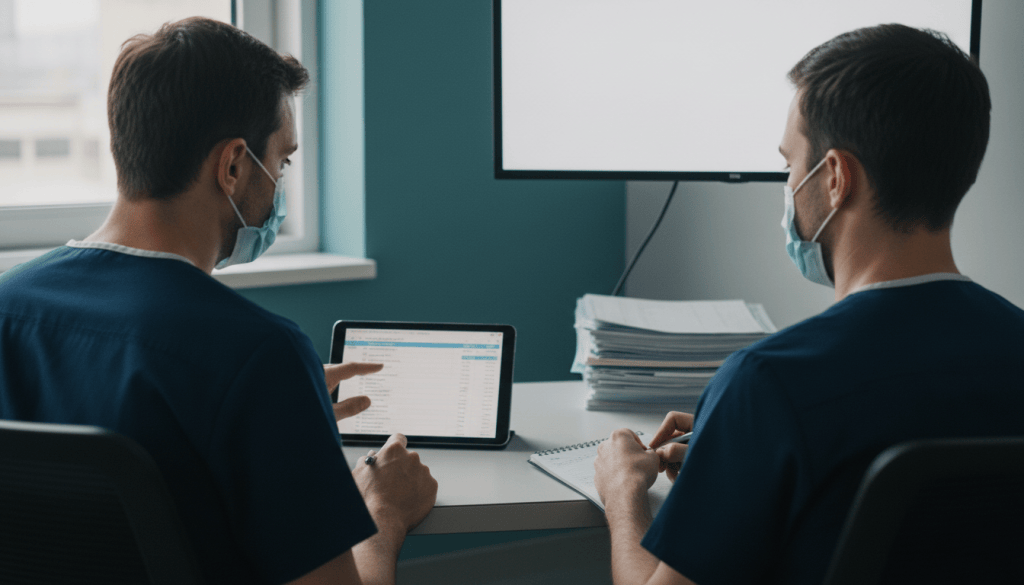
This is why senior residency can feel strangely harder even after your clinical knowledge and technical ability have improved. Your field of view has widened. You are no longer responsible only for whether your work is correct. You increasingly have to understand whether the team’s work makes sense as a whole.
The uncomfortable move from reporting to recommending
One of the clearest signs of progression is the move from presenting information to making a recommendation.
“The patient has abdominal pain and a rising inflammatory marker” is information. “I am concerned this trajectory is not consistent with routine recovery; I think we should reassess the abdomen, repeat the relevant labs, and discuss whether imaging is needed” is a clinical position.
The second statement exposes your reasoning. That is precisely why it can feel uncomfortable. Once you recommend something, you can be wrong.
But senior decision-making is not the ability to be certain before speaking. It is the ability to build a defensible working plan from incomplete information, state how confident you are, identify what would change the plan, and escalate when the consequences exceed your level of independence. That is closely related to the skill discussed in working with clinical uncertainty.
Being senior does not mean pretending you need less supervision
This is one of the traps of the transition. A resident who has finally become “the senior” may feel pressure to prove that the title is deserved by handling everything alone.
That is not what graduated responsibility means.
In the United States, the ACGME Common Program Requirements effective July 1, 2026 frame residency around progressive responsibility under appropriate faculty supervision. The practical principle is broader than one training system: increasing autonomy should track demonstrated ability, the complexity of the task, and the patient’s condition—not the resident’s desire to look independent.
A strong senior therefore becomes better, not worse, at recognizing the boundary of independent action. The question changes from “Can I manage this without calling?” to “At what point does senior input improve safety or change the plan?”
That distinction matters overnight, during deterioration, before invasive decisions, and whenever the clinical picture stops fitting the expected course. The practical mechanics are covered separately in When to Call Your Senior.
Your juniors change the job
Junior residents do not only create teaching opportunities. They change the senior resident’s workload.
If you delegate a task, you still need enough situational awareness to know whether it was completed and whether the result changes anything. If a junior presents a patient, you have to decide whether the assessment is sufficient or whether you need to see the patient yourself. If someone is struggling, you need to distinguish a normal learning gap from a problem that could affect patient care.

Good delegation therefore has two parts: transferring the work and retaining appropriate oversight. Doing everything yourself may feel safer at first, but it prevents juniors from developing and eventually makes the service less functional. Delegating everything without follow-up is not autonomy; it is loss of control.
Research on senior general surgery residents has described this “big picture” role directly. In a qualitative study of residents, effective seniors were characterized not simply by technical competence but by their ability to manage the overall patient-care picture, communicate expectations, and influence both the team and patient care. A 2025 study of a leadership curriculum for residents transitioning to senior roles similarly found that residents described competing demands: patient care, team dynamics, teaching, and their own continued development.
You are still learning while other people are learning from you
This is one of the oddest parts of senior residency. A junior asks you a question, and you may be only a few years—or sometimes a few months—ahead in that exact problem.
You do not need to perform certainty. If you know, explain your reasoning. If you are unsure, say so and show how you would resolve the uncertainty. If the question requires faculty judgment, involve faculty. Teaching someone how to verify an answer can be more useful than delivering a confident answer you have not checked.
The resident-as-teacher role is explored in more detail in The Resident Becomes the Teacher. The important point here is that teaching becomes part of your clinical responsibility rather than a separate educational activity.
The OR changes too
Senior responsibility is especially visible in the operating room, but it is not equivalent to “the attending leaves the room.” Entrustment is more nuanced than physical distance.
A systematic review of intraoperative entrustment found that autonomy is shaped by interacting resident, supervisor, case, patient, and contextual factors. More recent work examining supervisors and residents after operating together likewise emphasizes that good supervision can take different forms depending on the learner and situation.

For the resident, the useful question is not “How much did the attending let me do?” It is “Which parts could I plan, execute, recognize difficulty in, and recover from safely?” Those are different dimensions of independence.
National U.S. EPA data illustrate why seniority should not be mistaken for finished competence. In a 2025 study of PGY-5 general surgery residents, the median faculty entrustment rating was practice-ready for 16 of 18 core EPAs, but ratings continued to improve across the chief year. In July 2023, 56% of assessed chief-resident encounters were rated at indirect supervision or lower; by May 2024 that proportion had fallen to 26%. Even the final year remained a period of development.
That is reassuring. The goal of senior residency is not to arrive already finished. It is to use progressively larger responsibility to expose what still needs work before independent practice.
A useful senior creates clarity
On a busy service, residents often think leadership means being decisive. Decisiveness helps, but clarity is more important.
At the start of the day, the team should understand what matters most. After rounds, people should know who is doing what. When a plan changes, the change should reach the people who need it. When a junior raises a concern, it should be clear whether the senior has taken ownership of the issue. When the senior is uncertain, the team should know what is being checked and when the decision will be revisited.
This is less dramatic than “leadership,” but it is what makes a service work.
Do not become the senior you hated working with
Hierarchy is easy to reproduce. Residents who were taught through fear can start teaching through fear. Residents who were never allowed to operate may become protective of their own cases. Residents who were expected to know everything can punish juniors for not knowing things that are, in fact, learnable.
Seniority gives you enough local power to change the experience of the people below you, even when you cannot change the entire training system.
You can ask a junior what they think before giving the answer. You can correct an error without turning it into a character judgment. You can give someone an operative step when it is safe rather than automatically taking over. You can make it normal to escalate genuine concern. You can explain why the plan changed.
None of that requires lowering standards. In fact, clear expectations and psychological safety make it easier to see where the real gaps are. Related pieces on belonging in surgical residency and learning after being wrong look more closely at that side of training culture.
How to tell whether you are actually becoming more senior
The most useful markers are not whether people call you “senior” or how many cases are in your logbook.
You are progressing when you recognize important problems earlier; when your plans include what happens if the first plan fails; when you can prioritize the service without losing the vulnerable patient in the background; when juniors can bring you uncertainty without hiding it; when you can disagree with a plan respectfully and explain why; when you know which decisions you can make and which require escalation; and when you can leave a case or a shift knowing what you need to improve next.
That last part matters. Seniority should make your self-assessment more accurate, not your confidence more absolute.
The transition is supposed to feel unfinished
There is no morning when a resident wakes up and suddenly feels like the person everyone should ask.
Responsibility accumulates in smaller moments: making a plan before asking for one, catching the issue the team missed, helping a junior through a difficult task, realizing early that you need help, explaining a decision clearly, and eventually noticing that the service now looks to you before it looks past you.
The point is not to become the resident who never needs supervision. The point is to become someone who can carry progressively more responsibility safely, use supervision intelligently, and make the people working with you better.
Sources and Further Reading
- Accreditation Council for Graduate Medical Education. Common Program Requirements — Residency, effective July 1, 2026.
- Effective Senior Surgical Residents as Defined by Their Peers: A Qualitative Content Analysis of Nontechnical Skills Development. Annals of Surgery.
- “Stepping Out of a Comfort Zone”: Evaluating the Impact of a Leadership Skills Curriculum on Surgical Residents’ Transition to Senior Roles. Journal of Surgical Education. 2025.
- Practice Readiness of Chief Residents in a National Sample During the First Year of EPA Assessments. Annals of Surgery. 2025.
- Perceptions and Guiding Strategies to Regulate Entrusted Autonomy of Residents in the Operating Room: A Systematic Literature Review.
- The Many Faces of Good Operating Room Supervision: Supervisors’ and Residents’ Perspectives After Operating Together. Journal of Surgical Education. 2025.




Leave a Reply