
Last reviewed: October 27, 2026
There is a point in surgical training when being good at your own work stops being enough.
As a junior resident, much of the day is organized around questions such as: Did I see the consult? Did I chase the scan? Do I know the patient? Am I prepared for the case? As responsibility increases, the questions become larger: Does the team know which patient worries us most? Is the junior resident overloaded? Has the operation been prepared properly? Does the attending need to know this now? What can I safely let someone else do?
That is the real transition into a senior or chief role. It is not simply a promotion to more difficult operations. You begin to carry part of the architecture of the service.
The job changes before the title feels comfortable
A senior resident can have exactly the same number of hours in a day as everyone else and still be responsible for knowing much more of what is happening. The challenge is no longer to personally complete every task. It is to build enough situational awareness that the right work happens, in the right order, with the right level of supervision.
This is why the first senior rotations can feel strange. You may be technically stronger and clinically faster than a year earlier, yet the day can feel less controllable. Your attention is split between your own patients, juniors’ questions, the operating list, new consults, discharge problems, deteriorating patients, calls from other teams, and decisions that cannot all wait until rounds.

You stop managing tasks and start managing risk
Junior residents often experience the service as a long task list. Senior residents gradually learn to see a risk map instead.
Three patients may all need something done, but they do not need the senior resident’s attention equally. A stable patient waiting for routine paperwork is different from a patient whose physiology is drifting, a fresh postoperative patient with an unexpected finding, or a consult whose diagnosis could change quickly. The senior resident’s value is often not that they personally perform every action. It is that they notice which situation can no longer safely sit in the queue.
This connects directly to one of the hardest skills in residency: working through constant interruption without losing the important thread. At senior level, the thread is increasingly the whole service rather than one patient.
Supervising does not mean taking over
One of the most uncomfortable parts of becoming senior is learning not to rescue every junior resident immediately.
If you answer every question, write every plan, make every phone call and step into every procedure at the first hesitation, the service may move quickly for a few hours—but nobody below you develops. On the other hand, withholding help when risk is increasing is not education. It is poor supervision.
The useful middle ground is graded responsibility. Ask what the junior thinks. Make them commit to a plan when the situation allows it. Clarify what would make them escalate. Check back at a defined point. Step in earlier when the consequence of delay is high.
This is the same logic behind how residents earn operative autonomy: supervision changes with demonstrated competence, the complexity of the task, and the risk of the situation. The difference is that a senior resident is now helping make those supervision decisions for someone else.
The operating room feels different when you are responsible for someone else’s learning
Operating as a senior resident is not only about getting more of the case. In many teams, you also begin helping a junior resident through parts of an operation you can already perform.
That exposes a new layer of competence. Doing something yourself and explaining it clearly are different skills. You have to decide what the junior can safely attempt, where the attending expects you to intervene, how much verbal coaching is useful, and when the operation needs to move on.
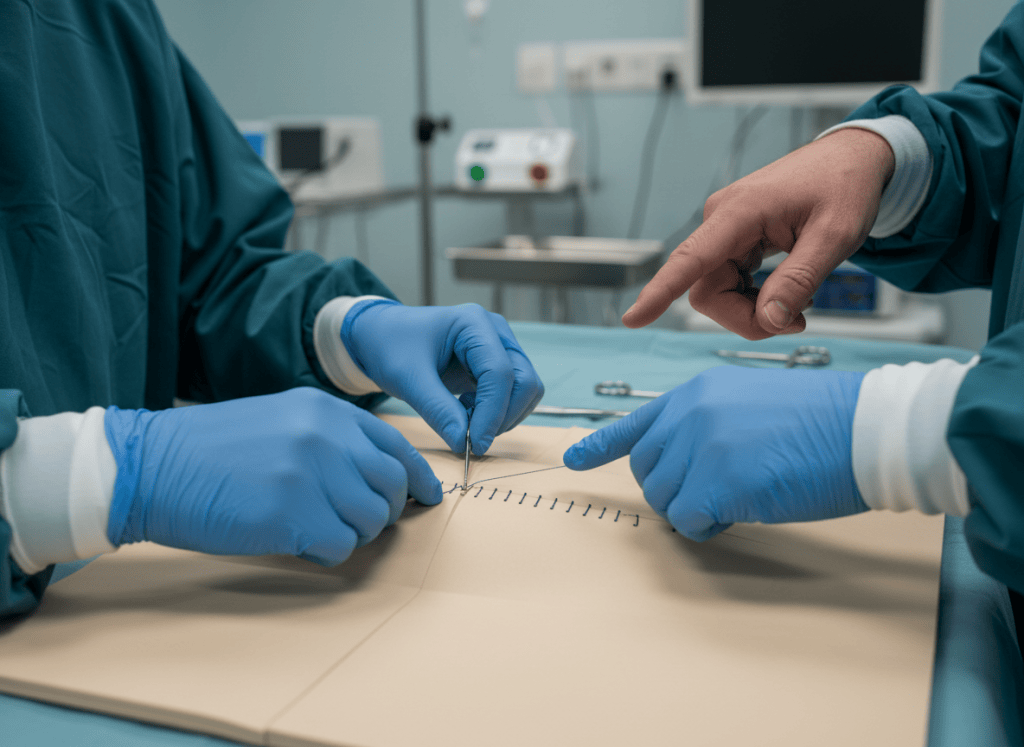
The same principle applies outside the OR. The senior resident becomes part of the teaching environment on rounds, during consults and at the workstation. Our guide to the resident-as-teacher role goes deeper into how to teach without turning every clinical moment into a lecture.
Delegation is a clinical skill
Delegation in surgery is sometimes misunderstood as simply distributing unpleasant work. Good delegation is much more specific: matching a task to someone’s ability, making the expected result clear, defining when they should come back to you, and then actually checking the result.
“Please review the patient” is weak delegation. “Please reassess the abdomen, check the latest vitals and urine output, and call me immediately if the pain is worse or the physiology has changed; otherwise update me in 30 minutes” creates a much clearer supervision loop.
The more senior you become, the more these loops matter. You cannot physically be everywhere. Your reliability depends partly on whether information returns to you before a problem becomes urgent.
The hardest escalation can be your own
Being senior creates a subtle trap: because other people now come to you for answers, it can become harder to admit when you need help.
But seniority does not remove uncertainty. It changes what you do with it. A strong senior resident knows the boundary between a problem they can continue working through and a problem the attending needs to know about now.
This matters especially when the patient is deteriorating, the diagnosis is uncertain, the proposed intervention carries meaningful risk, or the clinical course no longer fits the expected trajectory. Speaking up through surgical hierarchy remains a skill even when you have moved several steps upward in that hierarchy.
The formal training system is moving toward entrustment, not just time served
In U.S. general surgery, this shift toward responsibility is reflected in the formal training framework. The American Board of Surgery requires at least five years of progressive residency education and at least 54 months of clinical surgical experience with increasing levels of responsibility. It also requires chief-resident status for at least 48 weeks across the PGY-4 and PGY-5 years and at least 200 operative procedures as surgeon during the chief year.
Training is also becoming more explicitly competency-based. The ABS introduced 18 general-surgery Entrustable Professional Activities (EPAs) in July 2023. EPAs are intended to capture whether a resident can be trusted with core clinical activities at an appropriate level of supervision during actual patient care—not simply whether the resident has completed a rotation or accumulated a case number.
The current ACGME General Surgery requirements, effective July 1, 2026, likewise require programs to synthesize progressive resident performance toward unsupervised practice through Clinical Competency Committees and to review each resident’s progress at least semi-annually.
That distinction matters. Case volume is necessary, but a case log cannot tell you whether you can run a service, recognize when a junior needs help, prioritize three competing problems, communicate uncertainty, or make a safe plan at 2 a.m.
Leadership is not the same as being the loudest person
Surgical culture can make leadership look theatrical: confidence, speed, decisive instructions. Those qualities can be useful. They are not the whole job.
A team often functions better when the senior resident is predictable. Juniors know what should be escalated. Nurses know concerns will be heard. Attendings receive important information early rather than after a crisis. Work is distributed without disappearing. The plan after rounds is understandable. Feedback is specific rather than personal.
A 2025 qualitative study of residents transitioning into senior general-surgery roles found that participants described new responsibilities around team dynamics, teaching, developing their own abilities and, above all, maintaining patient care. That is a useful description of why this transition feels bigger than simply becoming more technically experienced.

A practical senior-resident mental model
When the service becomes busy, four questions can keep the senior role grounded:
- Who is sick? Which patient could deteriorate or needs a decision soon?
- Who is stuck? Which junior, consult, discharge, investigation or operation is not progressing?
- Who needs to know? What information needs to move upward, downward or across the team now?
- What can I safely let go? Which task can someone else own with an appropriate supervision loop?
This is not a substitute for local protocols or attending supervision. It is a way of thinking about the shift from completing work to coordinating safe work.
You are still a trainee
Perhaps the strangest part of senior residency is being both supervisor and supervised at the same time.
A junior resident may look to you as the person who knows what to do. Minutes later, you may be asking an attending to help with a decision you have never made independently. That is not a contradiction. It is the structure of advanced training.
The goal is not to become the person who never needs help. It is to become the person who can carry progressively more responsibility, recognize the limits of that responsibility, and use supervision before those limits become dangerous.
If the middle years of residency are about moving from “not new” toward genuine independence, the senior years add another question: can you help the whole team function while you make that transition yourself?
Sources and further reading
- American Board of Surgery — Certification Process and Residency Requirements.
- American Board of Surgery — General Surgery Training Requirements.
- American Board of Surgery — Entrustable Professional Activities for General Surgery.
- ACGME — Program Requirements for Graduate Medical Education in General Surgery, effective July 1, 2026.
- Kochis MA et al. “Stepping Out of a Comfort Zone”: Evaluating the Impact of a Leadership Skills Curriculum on Surgical Residents’ Transition to Senior Roles. Journal of Surgical Education. 2025.
This article describes general principles of surgical training and does not replace local supervision, hospital policy, or program-specific requirements.





Leave a Reply