Last reviewed: October 27, 2026.
Fatigue in surgical residency is easy to describe badly. From the outside, it becomes a story about heroic hours or impossible schedules. From inside training, the more useful question is narrower: what changes in the way you work when you are tired?
The answer is not simply that you feel sleepy. A long call, repeated night shifts, interrupted sleep or a compressed service day can change attention, memory, communication and the amount of effort required for decisions that would normally feel routine. The resident still has to review the scan, answer the page, notice the abnormal trend, prepare for the next case and hand over safely.
This is not an argument that every tired resident is unsafe, and the research is more nuanced than that. It is an argument for treating fatigue as a clinical working condition that has to be recognized and managed rather than as a character test.
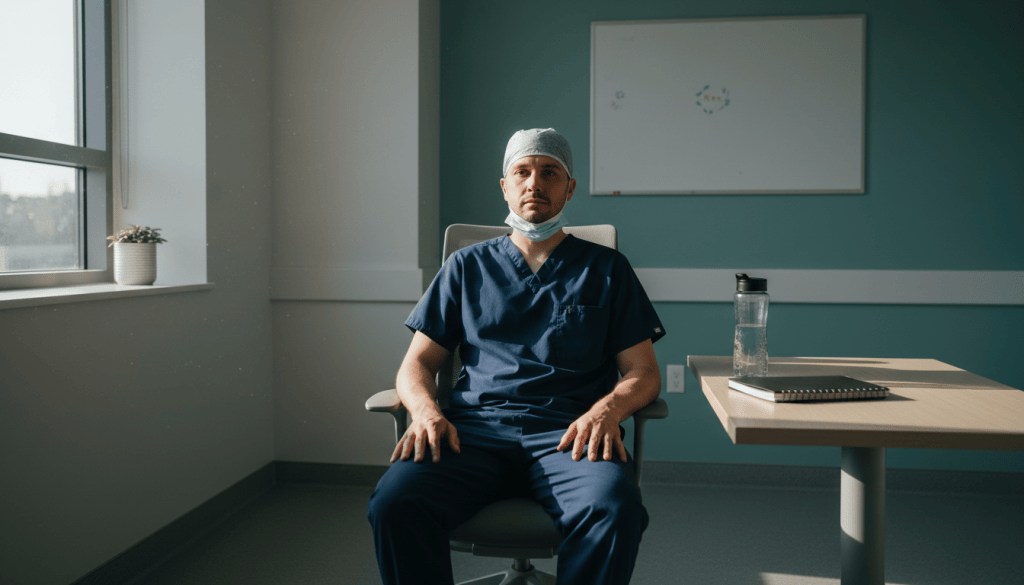
Fatigue rarely announces itself dramatically
Residents often imagine fatigue as the point where someone is visibly unable to stay awake. In practice, the earlier changes matter more. You may reread the same laboratory result. You may need longer to reconstruct why a patient is still in hospital. A routine page can feel disproportionately irritating. You may notice that you are narrowing your attention to the task immediately in front of you and thinking less naturally about what comes next.
That matters in surgery because so much resident work is anticipatory. Good ward work is not only completing today’s orders; it is noticing the patient who is drifting in the wrong direction. Good operating-room preparation is not only knowing the steps; it is anticipating anatomy, equipment and the next decision. Good call is not only responding to pages; it is continually reprioritizing a changing list.
A 2024 study of resident physicians found more themes associated with problematic clinical reasoning when sleep restriction was combined with distracting contextual factors. That combination is familiar to anyone working an inpatient surgical service: fatigue rarely arrives in a quiet room with one problem at a time.
The dangerous part is not always the technical task
Surgeons understandably worry about fine motor performance after poor sleep. But some evidence suggests the effects can appear just as importantly in non-technical domains. In a prospective study of surgeons performing procedures after call, post-call status was associated with poorer ratings for situational awareness, decision-making and communication/teamwork, even though procedural errors were uncommon.
That distinction is useful for residents. A tired trainee may still be able to tie a knot or close a wound perfectly well. The more vulnerable point may be deciding which problem deserves attention first, remembering to communicate a change, recognizing that a familiar postoperative pattern is no longer familiar, or realizing that the plan needs senior input.
This is one reason the site’s guide to recognizing postoperative deterioration emphasizes trends and reassessment rather than isolated numbers. When attention is stretched, structure becomes more valuable.

The practical response is to externalize more of your thinking
On a well-rested day, residents can carry an uncomfortable amount of information in working memory. After a difficult night, relying on that ability becomes a bad bargain. The useful adjustment is not to “try harder” to remember everything. It is to move more of the work out of your head.
Keep the active problem list current. Write down the call you promised to make. Mark the laboratory value that needs repeating. Before leaving a patient, ask what the next decision point is and who owns it. During a handoff, state the contingency rather than assuming the next resident will infer it.
This is the same principle behind a strong surgical handoff: the goal is not to prove how much you remember. The goal is to make the next safe action obvious.
Reduce avoidable decisions
A busy surgical shift contains hundreds of small choices. Which page comes first? Do you finish the note before calling radiology? Can this request wait until after rounds? Is this change expected enough to watch, or does it need review now?
Recent observational work in ICU physicians has begun separating sheer decision volume from the way decisions cluster across a shift. The evidence is still developing, but the underlying resident-side lesson is practical: when the service is busy, unnecessary choice creates friction.
Simple routines help. Use the same pre-round sequence. Prepare cases with a repeatable framework. Keep one task system rather than three. Group non-urgent calls when clinically appropriate. Do not repeatedly decide whether an unstable patient deserves reassessment; build reassessment into the plan.
The point is not productivity optimization for its own sake. It is preserving cognitive bandwidth for the decisions that actually require judgment.
Fatigue should lower the threshold for a second set of eyes
Surgical culture can make asking for help feel like a statement about competence. Fatigue makes that interpretation particularly unhelpful. If you are uncertain whether your assessment is complete, asking a colleague or senior to review the situation is not surrendering responsibility. It is using the team.
The same applies to the operating room. A resident who notices that concentration is poor should not hide that fact to protect an image of toughness. Supervision exists precisely because clinical responsibility depends on resident ability, patient complexity and available support—not only postgraduate year.
The 2026 ACGME requirements explicitly require programs to educate residents and faculty to recognize fatigue and sleep deprivation, provide fatigue-mitigation processes, and ensure sleep facilities and safe transportation options for residents who may be too fatigued to return home safely. They also state that using fatigue-mitigation strategies should not carry negative consequences or stigma.
That is worth reading literally. Fatigue management is part of professional practice, not evidence that someone is insufficiently committed to surgery.
There is a difference between being tired and being unable to work safely
Residency cannot eliminate tiredness. Surgery includes nights, emergencies and unpredictable workloads, and learning to function responsibly under imperfect conditions is part of training. But that does not mean every degree of fatigue should be normalized.
A useful internal question is not simply, “Am I tired?” It is: what is fatigue doing to my performance right now? Are you losing track of tasks? Repeatedly missing information? Struggling to stay awake? Becoming unable to maintain attention during a critical activity? Finding that your judgment feels less reliable?
Those are reasons to change the working setup—use supervision, redistribute tasks where possible, take an appropriate rest opportunity, or use the program’s fatigue-mitigation pathway. The exact mechanism depends on the hospital and the clinical situation.
What the evidence does—and does not—say
It is tempting to reduce the literature to “sleep deprivation causes surgical errors.” The evidence is not that simple. A systematic review of fatigue and insufficient sleep found clear concerns for physician health and well-being but mixed evidence for surgical performance and medical errors. More recent work continues to show measurable effects on sleep, cognition and non-technical performance, while direct patient outcomes vary by study design and setting.
A 2025 systematic review and meta-analysis covering 108 studies found that shorter resident shifts were associated with better resident well-being and less fatigue while patient-safety outcomes were broadly maintained; educational effects, including operative experience, were mixed. That is an important reminder that duty-hour policy always involves several goals at once: patient safety, continuity, education and resident health.
For the individual resident at 3:40 a.m., however, the literature does not need to produce a universal cutoff to be useful. The practical conclusion is simpler: fatigue can alter performance, people vary, and systems should make it possible to recognize and mitigate it before a resident has to prove impairment by making a mistake.
A simple fatigue check before the next high-stakes task
Before a major decision, procedure, difficult conversation or handoff late in a shift, run a short mental check:
- Attention: Am I actually following the information, or repeatedly rereading it?
- Priorities: Can I state the most important problem and the next decision clearly?
- Memory: What am I currently trusting myself to remember that should be written down?
- Verification: Is there anything important I should deliberately double-check?
- Support: Would another resident, nurse, fellow or attending seeing this now make the decision safer?
This is not a validated clinical score. It is a working habit: a way to notice when your normal operating mode has changed.
The resident lesson is not “be tougher”
Surgical training inevitably teaches endurance. That can be useful. A resident has to remain functional when the list runs late, when an emergency arrives near the end of a shift, and when the night is busier than expected.
But endurance is not the same as pretending physiology has stopped applying to you. A more mature form of toughness is knowing what changes when you are tired and adjusting before those changes become someone else’s problem.
That means using structure when memory feels less reliable, communicating more explicitly when attention is fragmented, asking for another set of eyes when judgment feels uncertain, and treating recovery after call as part of the work rather than an optional reward. For the practical side of that last step, see The Post-Call Day.
Sources and Further Reading
- ACGME — General Surgery Program Requirements and FAQs (current requirements effective July 1, 2026).
- Collen J, et al. Exploring sleep duration and clinical reasoning process in resident physicians. J Clin Sleep Med. 2024.
- Impact of sleep deficiency on surgical performance: a prospective assessment.
- The impact of shortening shifts of physicians during residency on patients and physicians: systematic review and meta-analysis. 2025.
- Impact of fatigue and insufficient sleep on physician and patient outcomes: a systematic review.





Leave a Reply