Last reviewed: October 27, 2026.
A skills lab can look like the easiest part of surgical education to understand. There is a task. There is a model. You repeat the task until your hands become faster.
That description misses most of what makes simulation useful.
The difficult part of learning surgery is not accumulating repetitions. It is identifying what is actually failing inside a movement or decision, changing it deliberately, getting feedback, and then carrying the improved version back into a real operation where anatomy, exposure, assistance, time pressure and consequences are completely different.
That is why a resident can spend an hour tying knots and learn very little, while ten carefully observed repetitions can change how the next case feels.
Simulation is now part of the curriculum, not an optional extra
In the United States, the ACGME General Surgery Program Requirements effective July 1, 2026 explicitly require a simulation-based curriculum that complements clinical experience and is tailored to the resident’s level of skill. The same requirements emphasize safe technical skills, appropriate supervision and progressive autonomy.
That matters because simulation solves a problem that operating-room volume alone cannot solve: real cases are not designed around your learning needs.
You may need to improve needle angles, but the next operation may give you only two sutures. You may want to practice a laparoscopic movement repeatedly, but a patient cannot become a repetition device. You may understand a procedure intellectually yet rarely encounter the exact step that gives you trouble.
The skills lab creates something the clinical environment cannot: permission to isolate a problem and repeat it without exposing a patient to the learning curve.
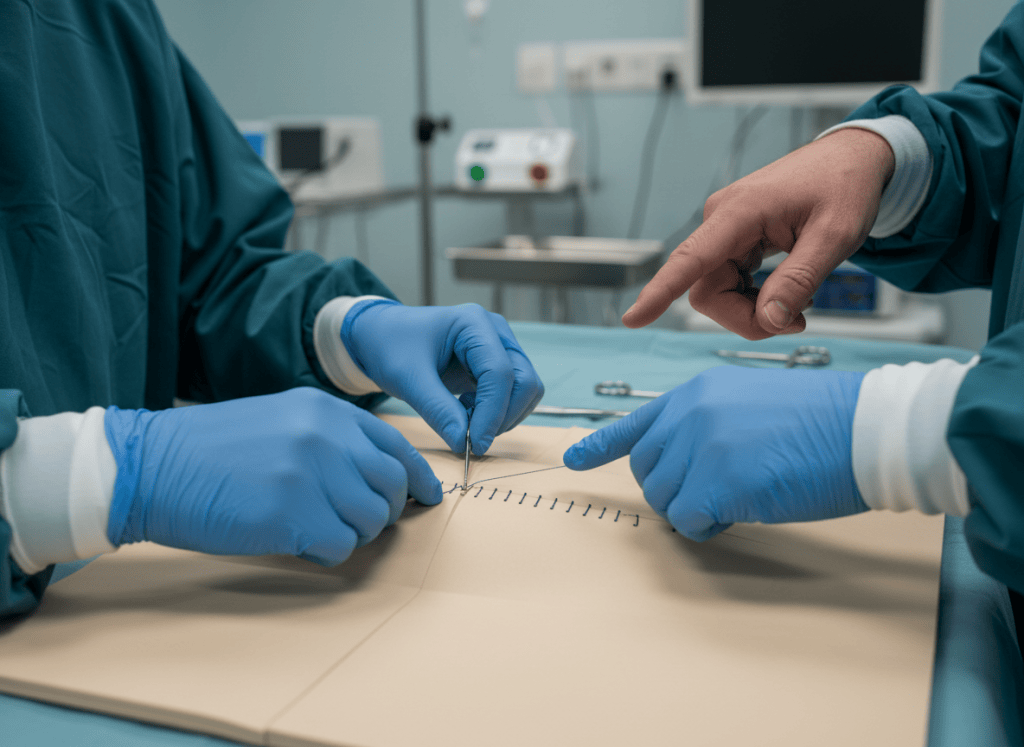
The resident mistake: practicing the whole skill when only one part is weak
Imagine that your laparoscopic suturing is slow. “Practice laparoscopic suturing” sounds like a plan, but it is not yet a useful diagnosis.
Where is the time actually disappearing?
- Is the needle poorly oriented before it reaches the tissue?
- Does your nondominant hand stop contributing?
- Are you repeatedly losing the correct depth?
- Is the bite acceptable but intracorporeal knot tying inefficient?
- Do your movements become larger when the camera angle changes?
Those are different problems. Repeating the entire sequence may simply rehearse the same error.
This is where deliberate practice differs from generic repetition. A 2025 systematic review of deliberate-practice approaches in simulation-based open surgical training found that included studies generally reported improvement in surgical skills, while also showing that the quality and structure of deliberate-practice implementation varied substantially. Feedback and repetition were common elements.
For a resident, the practical lesson is simple: make the practice target smaller than the procedure.
A useful skills-lab session starts in the OR
The best practice target often appears during a real case.
Not “I was bad at that operation.” That is too broad to act on.
Instead: “I repeatedly needed the needle repositioned before the backhand bite.” Or: “My left hand stopped providing counter-traction when the dissection became difficult.” Or: “I knew the sequence, but instrument exchanges made every step feel disorganized.”
Those observations convert a vague impression into a trainable problem.
This also makes post-case feedback much more useful. Instead of asking a senior surgeon, “How did I do?”, you can ask, “My needle positioning felt inefficient. Was the problem the entry angle, how I loaded it, or both?” That kind of question is much more likely to produce something you can reproduce in practice.
If feedback in your program tends to end at “good job,” the site’s guide on getting useful feedback in surgical residency goes deeper into how to ask for something actionable.
Do not practice until you are tired. Practice until you have an answer.
Residents have limited time. A useful simulation session therefore needs an endpoint other than exhaustion.
A practical structure is:
- Name one failure. “My instrument crosses the camera whenever I work in the upper-left quadrant” is better than “I need more laparoscopy practice.”
- Define what better looks like. Fewer unnecessary movements? Consistent needle entry? Less tension on the suture? A cleaner sequence?
- Perform a small number of baseline repetitions. Watch what actually happens instead of relying on memory.
- Change one thing. Position, grip, port geometry, sequence, traction, visual target or movement economy.
- Repeat with immediate feedback. If possible, use a faculty member, senior resident, objective checklist or video review.
- Stop and record the lesson. One sentence is enough: what changed, and what will you try in the next real case?
This is less satisfying than mindlessly accumulating repetitions because it exposes the exact point where your technique breaks. That is also why it is more useful.
The ACS curriculum shows how broad “technical skill” really is
The ACS/APDS Surgery Resident Skills Curriculum is divided into three phases. Its early core-skills modules range from asepsis, knot tying and suturing to chest tube insertion, central venous access, laparotomy closure, laparoscopy and bowel or arterial anastomosis. The advanced phase includes simulations of procedures such as appendectomy, hernia repair and colon resection. A third phase addresses team-based skills, including handoffs and emergency scenarios.
That breadth is important. “Surgical skill” is not just dexterity. It includes procedural sequence, economy of movement, communication, anticipation, equipment familiarity and knowing when the situation has moved beyond your current level.
The ACS Fundamentals of Surgery Curriculum makes a similar point from the cognitive side: its simulated cases ask early residents to recognize findings, order tests, interpret information, initiate treatment and decide when senior help is needed.
In other words, simulation can train hands, but it can also train the moment when a resident decides, I should not manage this alone.
Why fast on the simulator does not automatically mean good in the OR
A simulator deliberately removes complexity. That is its strength and its limitation.
The model does not bleed unexpectedly. Exposure does not deteriorate because the assistant changed angle. Tissue quality is predictable. Nobody is waiting for pathology. The attending is not simultaneously teaching, supervising and managing the room. There is no real patient attached to the technical decision.
So the goal is not to “win” the simulator. It is to make a component of the real operation less cognitively expensive.
If needle handling becomes automatic, you have more attention available for tissue quality and spacing. If camera navigation becomes smoother, you can think about anatomy instead of fighting orientation. If a procedural sequence is rehearsed, you are more able to notice when the real case departs from the expected sequence.
That is transfer: not reproducing the lab perfectly, but freeing enough mental bandwidth to manage the parts the lab cannot reproduce.
The loop that matters: OR → practice → OR
Simulation is most useful when it sits between real clinical experiences rather than beside them.
Case: identify one specific technical or cognitive problem.
Debrief: verify that your diagnosis of the problem is correct.
Practice: isolate it, slow it down, repeat it and get feedback.
Next case: deliberately look for the moment when that skill appears again.
Reassess: did the change survive contact with real anatomy and real workflow?
This is also closely related to how residents earn operative autonomy. Independence is not awarded because a resident has logged enough simulator hours. It grows when supervisors repeatedly see preparation, technical control, judgment, communication and the ability to recognize limits.
What to practice when you do not know what to practice
Early in residency, almost everything can feel weak. Trying to improve everything at once usually produces scattered practice.
Start with skills that recur across many cases: knot security, needle loading, two-handed instrument use, atraumatic tissue handling, camera navigation, basic laparoscopic coordination, opening and closing, and common bedside procedures appropriate to your training level and local supervision.
Then let your clinical work narrow the target. If tomorrow’s list includes a procedure you know you may participate in, the site’s 15-minute case-preparation framework can help identify the steps and anatomy worth reviewing before deciding whether a technical component is suitable for simulation.
Mid- and senior-level residents can use the same logic for more complex tasks. The ACS/APDS advanced curriculum itself progresses to procedure-level simulations. The principle does not change: isolate what can safely be rehearsed, then reconnect it to the whole operation.
Keep a tiny technical learning log
You do not need a spreadsheet with fifty metrics. After a case or practice session, four lines are enough:
- Skill: What was I trying to do?
- Failure: Where did it break down?
- Change: What adjustment improved it?
- Next exposure: Where am I likely to test this again?
Over months, that record is more informative than “need to improve technically.” It also helps when residency progress feels invisible, especially in the middle of training when expectations rise faster than your perception of improvement.
The skills lab should make the next operation quieter in your head
The best result of simulation is not a beautiful practice pad or a fast box-trainer time.
It is arriving at the same technical moment in a real operation and realizing that one part no longer consumes all of your attention.
Your hands know where to go. You can see the tissue instead of thinking about the instrument. You have enough mental space to listen, anticipate, notice a change and make the next decision.
That is what the repetition was for.
Sources and Further Reading
- ACGME Program Requirements for Graduate Medical Education in General Surgery, effective July 1, 2026.
- American College of Surgeons / APDS Surgery Resident Skills Curriculum.
- ACS Fundamentals of Surgery Curriculum.
- The Use of Deliberate Practice in Simulation-Based Surgical Training for Open General and Subspeciality Surgery: A Systematic Review (2025).




Leave a Reply