
Last reviewed: October 27, 2026
There is a strange point in surgical training when you realize that someone is watching you the way you used to watch the senior residents.
You are still asking attendings questions. You still have cases you have never done independently. You still get corrected. But now a medical student is waiting for you to explain why the patient is still NPO, an intern wants to know how worried to be about a drain, and someone in the skills lab is copying the way you hold a needle driver.
No ceremony marks the change. You simply become a teacher while you are still very much a trainee.
That is one of the least discussed parts of surgical residency. Teaching is not something reserved for the attending at a whiteboard. Much of it happens resident to resident, resident to student, and often in the middle of actual work.
Why residents end up teaching so much
Residents occupy an unusually useful position in the training hierarchy. They know enough to make clinical decisions, but they are still close enough to the beginner stage to remember which parts were confusing.
A senior surgeon may see a postoperative course as a familiar pattern. A resident may remember that, two years earlier, they did not know which changes in that pattern mattered. That proximity can make residents particularly effective near-peer teachers.
The evidence supports taking this role seriously. A 2026 review of resident-as-teacher research found that residents across specialties commonly see teaching as part of their professional identity, while formal preparation for the role remains inconsistent. A 2025 systematic review of peer and near-peer teaching in surgical education found improvements in learner confidence and technical proficiency, with outcomes for basic surgical skills often comparable with faculty-led instruction when the teacher’s experience matched the complexity of the skill.
In the United States, the current ACGME General Surgery requirements also make education an explicit part of the training environment: programs must provide organized clinical teaching conferences, patient-safety and quality-improvement conferences, protected conference time, and simulation-based education. The exact way residents teach on a service varies enormously by program and country, but the educational role is not an accidental extra.

Most resident teaching does not look like a lecture
On a busy surgical service, the fantasy version of teaching is a perfectly prepared 30-minute discussion with everyone seated and attentive. The real version is often 90 seconds between two patients.
A useful resident teacher learns to work with that reality rather than waiting for ideal conditions.
On rounds: teach the decision, not the textbook chapter
If a student presents a patient after colectomy, the highest-value teaching point may not be a full review of colorectal surgery. It may be one question: What would have to change today for us not to advance the diet?
That question forces the learner to connect symptoms, examination, physiology and the plan. It also reveals how surgeons think.
The same principle improves surgical presentations on rounds: teach learners to identify the decision the team needs to make, not simply to recite every available fact.
In the OR: set one learning target before the case
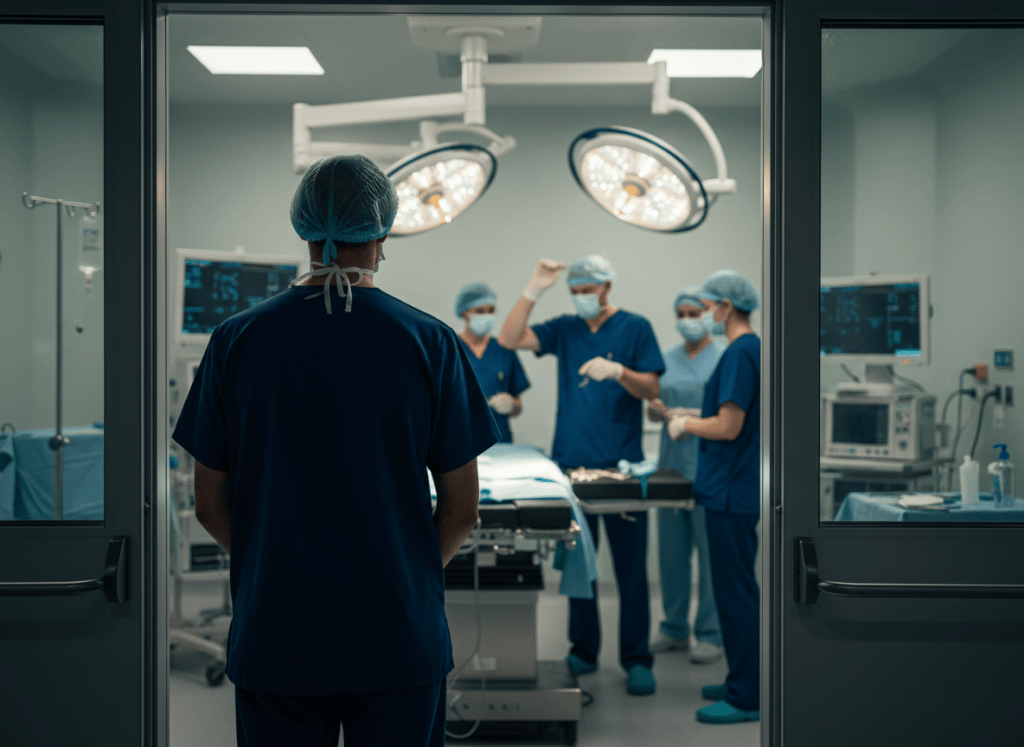
The operating room can be a terrible classroom if the learner does not know what to watch for. There is too much happening at once.
A resident can make it more useful by giving the junior learner one target before the operation: identify the relevant anatomy, predict the next step, understand why the patient was selected for surgery, or practice one technical task at the appropriate level.
That is closely related to good preoperative case preparation. A learner who understands the indication and sequence can ask better questions than one encountering every step for the first time.
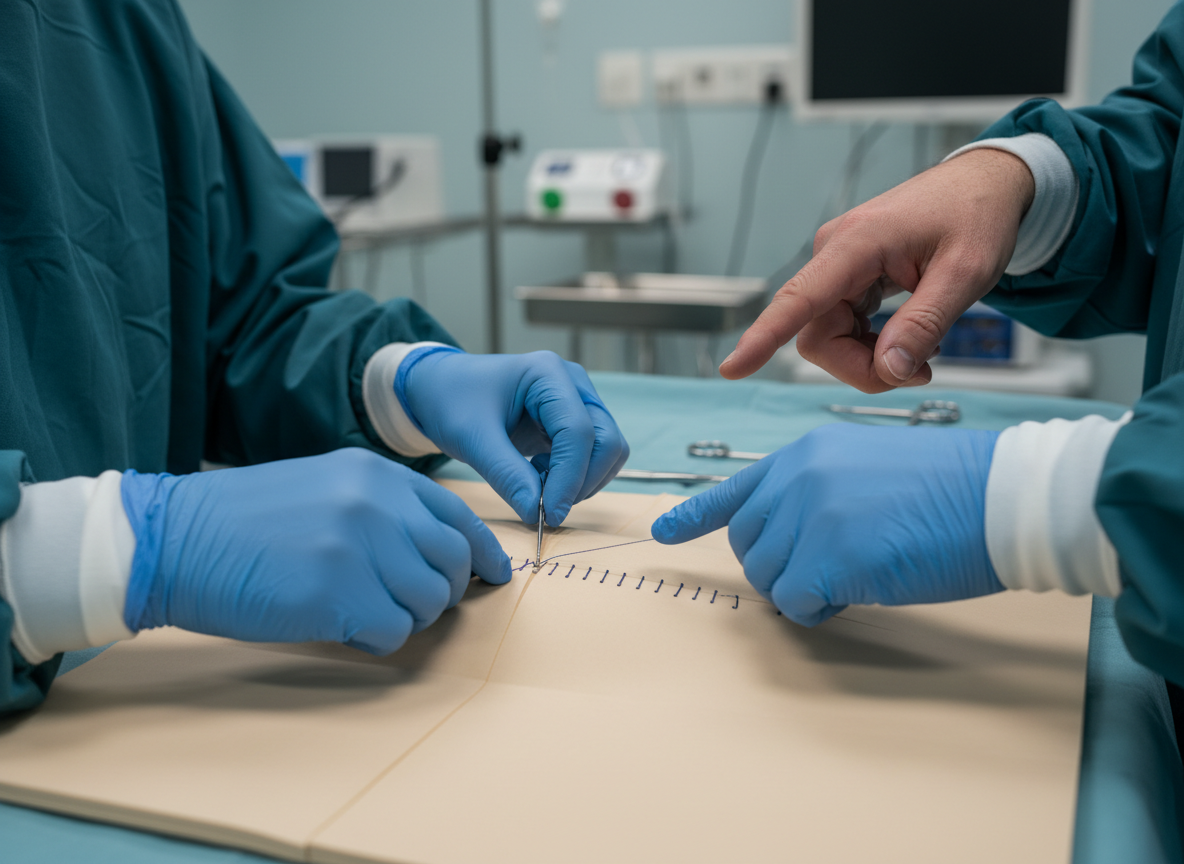
In the skills lab: demonstrate less, observe more
Technical teaching becomes weak when the teacher performs the task beautifully while the learner watches. The useful part begins when the learner tries it.
For a basic skill, a resident can demonstrate the movement once, let the learner perform it, identify the single biggest limiting error, and repeat. Correcting five things at once usually gives the learner five things to forget.
This fits the deliberate-practice approach discussed in our guide to using the surgical skills lab effectively.
The difficult skill: teaching without slowing unsafe work
Residents often feel a conflict between service and education because the conflict is real. A deteriorating patient does not become less urgent because a student needs teaching. An OR start time does not move because an intern wants a physiology review.
The answer is not to teach constantly. It is to recognize which moments can carry teaching and which cannot.
When the situation is urgent, act. When the task is routine, invite the learner into the reasoning. When a useful question would take ten minutes to answer, save it for later rather than giving a rushed half-answer while distracted.
One practical habit is to keep a mental parking lot: “That is a good question. Remind me after rounds.” The important part is actually returning to it.
Do not use questions as a performance
Surgical teaching has a long association with rapid questioning. Questions can be excellent educational tools. They become poor tools when their purpose changes from discovering what the learner understands to displaying what the teacher knows.
A useful question has somewhere to go.
- “What are you worried about here?” tests prioritization.
- “What finding would change our plan?” tests decision-making.
- “What structure are we trying to protect in this step?” connects anatomy to technique.
- “What would make you call the senior resident tonight?” teaches escalation.
If the learner does not know, the next move is teaching—not humiliation.
This matters especially in surgery because hierarchy is already powerful. The same environment that makes speaking up difficult for residents can make it even harder for a student to admit uncertainty.
Feedback works better when it is small and specific
“Good job” is pleasant and almost useless. “Read more” is usually too broad to act on.
A resident does not need to deliver a formal evaluation after every interaction. One concrete observation can be enough: your presentation was accurate, but lead with the active problem; your knot is secure, but your hand movement is creating unnecessary tension; you recognized the abnormal vital signs, but escalation came too late.
Then give the learner another chance to do the same task. Feedback becomes much more valuable when it can immediately change the next attempt. The same principle applies when residents seek better feedback for themselves.

Teaching exposes what you do not understand
This is one of the hidden benefits of becoming the teacher.
It is easy to feel that you understand a topic when you can recognize the correct answer. Explaining why a patient needs an operation, why a drain can come out, or why one approach is preferred over another is harder. The gaps become visible quickly.
A good resident teacher is comfortable saying, “I am not sure.” That is not a failure of teaching. Pretending certainty is.
Look it up, ask someone more experienced, and return with the answer. That models something more important than recall: how a doctor handles the edge of their knowledge.
What changes as you become senior
Early in residency, teaching may mean showing a student how the list works or explaining the structure of a presentation. Later, the responsibility becomes more consequential. Senior residents teach junior residents how to prioritize consults, prepare for cases, recognize when a postoperative course is no longer normal, and decide when to escalate.
Eventually, teaching overlaps with supervision. You are no longer only explaining what you would do. You may be deciding what another trainee can safely do while you remain responsible for noticing when they need help.
That transition mirrors the broader process of earning operative autonomy. Surgical training gradually changes from being watched, to being trusted, to helping decide how much trust someone else is ready for.
A simple resident teaching framework
When there is no time for a formal lesson, four steps are enough:
- Find the learner’s level. Ask what they already understand.
- Choose one objective. Do not teach the entire subject.
- Make them do the thinking or the task. Watching is not the same as learning.
- Give one actionable correction. Then let them try again when possible.
It is deliberately small because resident teaching has to survive the clinical day.
The part nobody tells you
Becoming useful to someone junior can feel uncomfortable because residency does not suddenly make you feel finished. Usually the opposite happens: the more you learn, the more clearly you see what you still do not know.
But that is precisely why residents can be good teachers. You do not need to be the final authority. You need to be one step—or several steps—ahead, honest about the limits of your knowledge, and able to make the next step clearer for someone else.
At some point, teaching stops feeling like an extra duty and starts looking like part of becoming a surgeon.
Sources and further reading
- ACGME — Surgery Program Requirements and FAQs (requirements effective July 1, 2026).
- Residents as Teachers in postgraduate medical education: a structured review of global evidence and emerging gaps (2026).
- Peer and Near-Peer Teaching Models in Surgical Education: A Systematic Review (literature searched through May 2025).
- “Residents as Teachers” Workshop Improves Knowledge, Confidence, and Feedback Skills for General Surgery Residents (Journal of Surgical Education).
- Improving Resident-Led Medical Student Education With Premade Chalk Talks (Journal of Surgical Education, 2025).




Leave a Reply