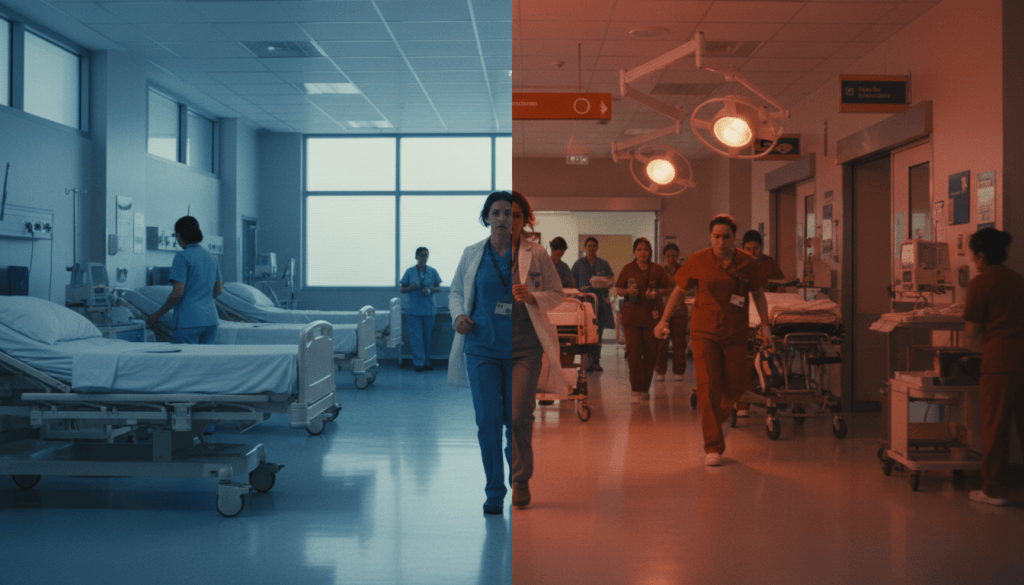
A surgical day can be emotionally strange because the hospital does not give you a transition period.
You can spend forty minutes solving a discharge problem, then be called to a patient who is deteriorating, then return to the same desk and continue the discharge as if nothing happened. The work changes speed. Your nervous system does not always change speed with it.
Urgency is often surrounded by normality
One of the oddest parts of hospital life is how quickly ordinary routines continue around serious moments. Someone is ordering lunch. A phone rings. A printer jams. A patient needs urgent review. Another patient wants to know when they can go home.
Residency teaches you to move between those worlds without expecting the environment to acknowledge the transition.
The shift back to routine can feel harder than the urgent moment
During an urgent problem, attention narrows. There is a task, a team, and a next decision. Afterward, the ordinary work returns: notes, calls, follow-up, forms, rounds.
That is when the emotional residue can become noticeable. You may feel unusually quiet, irritable, distracted, or simply tired. The event is over, but your attention has not fully reset.
Residents often learn to reset through small rituals
The reset does not need to be dramatic. It may be checking the task list again, getting water, stepping somewhere quiet for a minute, speaking briefly with a colleague, or deliberately asking, “What was I doing before this?”
Those small acts help restore sequence after the day has broken it.
Not every difficult moment needs to become a lesson immediately
Medical culture often turns experience into education very quickly: what happened, what could be improved, what should we do next time?
Reflection matters. So does allowing a difficult moment to be difficult before forcing it into a teaching point. Some experiences are understood later, after the shift has ended and the urgency has left the room.
The team matters after the crisis too
Good teams do more than coordinate during urgent work. They notice what happens afterward. A brief check-in, a clear debrief when appropriate, or simply acknowledging that the event was significant can make the return to ordinary work less isolating.
From the resident side
Surgical residency is not emotionally intense every minute. That would almost be easier to understand. Instead, intensity appears unpredictably inside long stretches of normal work.
Learning the job means learning not only how to respond when the pace changes, but how to return afterward without pretending the change never happened.
Related reading: Surgical Residency When You’re Tired, Night Float in Surgical Residency, and Belonging in Surgical Residency.





Leave a Reply