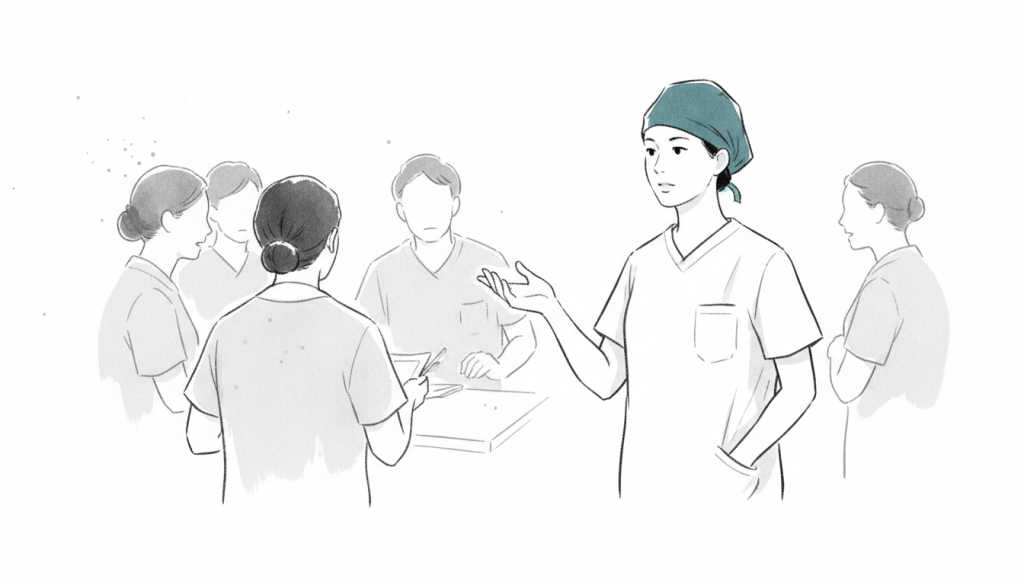
There is a stage in training where the answer exists in your head before it exists in your voice.
You have reviewed the patient. You have a working impression. You even know what you think should happen next. Then someone senior asks, “So what do you think?” and the answer suddenly feels less certain because it now has to survive being spoken.
Speaking turns private reasoning into public judgment
That transition is uncomfortable. Inside your head, a thought can stay provisional. Once you say it aloud, it can be challenged, corrected, or shown to be incomplete.
But that is also how clinical reasoning becomes trainable. Supervisors cannot refine reasoning they cannot see.
Confidence is not the absence of uncertainty
Early residents sometimes imagine that senior doctors feel certain all the time. Usually the difference is not certainty. It is that experienced clinicians can state a provisional judgment while keeping uncertainty visible.
“My leading concern is X because of A and B. I am less certain about C, and that is the part I want to clarify.”
That is confident communication without pretending to know more than you do.
Hierarchy makes hesitation louder
It is easier to state an opinion when nobody important is listening. Surgery often places learning inside hierarchy. The attending, senior resident, anesthetist, nurses, students, and others may all be present when you are asked to commit to an assessment.
That is why psychologically safe teaching matters. Residents improve faster when disagreement and correction are treated as part of training rather than as humiliation.
Use structured language until confidence catches up
If speaking freely feels difficult, structure helps. State:
- what you think is happening;
- the evidence that supports it;
- what worries you;
- what you would do next;
- what part you are uncertain about.
This gives your senior something concrete to respond to and makes feedback more useful.
Confidence grows from survived corrections
A surprisingly important part of training is discovering that being corrected does not end the conversation. You say what you think. Someone adjusts it. You understand why. The patient remains cared for. You use the new framework next time.
After enough repetitions, being wrong becomes less threatening because correction has become familiar rather than catastrophic.
From the resident side
The awkward phase between knowing and saying is not evidence that you lack judgment. It is often the stage where judgment is becoming visible enough to be tested.
Confidence in residency is rarely a sudden personality change. It is the accumulation of moments in which you thought, spoke, were corrected when needed, and came back the next day willing to do it again.
Related reading: Speaking Up in Surgery, Imposter Syndrome in Surgical Residency, and How to Get Useful Feedback.






Leave a Reply