Last reviewed: October 2026.
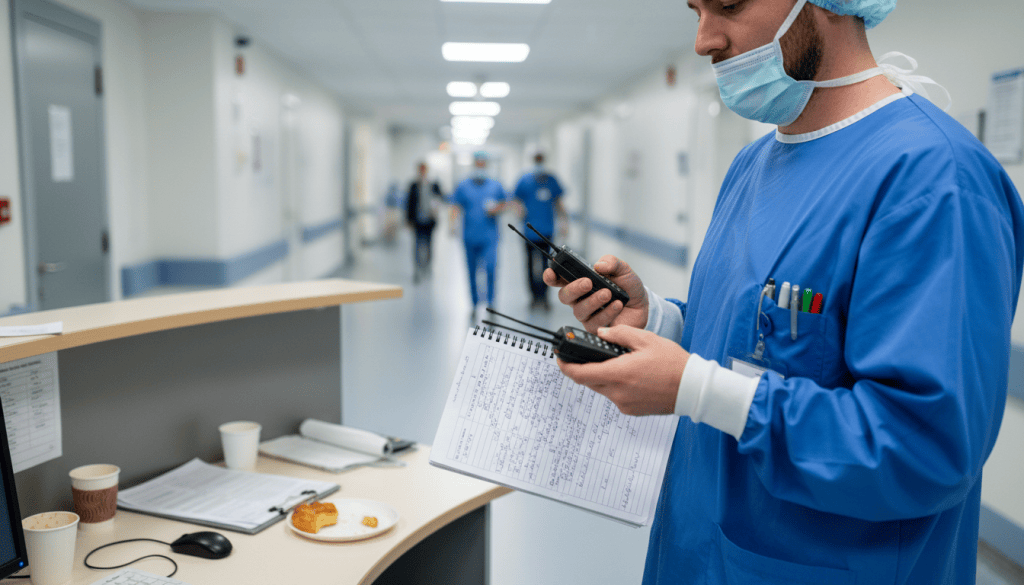
A surgical resident can be doing the right thing and still feel as if the shift is falling apart. You are reviewing a postoperative patient, a nurse calls about another patient, the emergency department sends a consult, someone asks whether a discharge is ready, your senior wants an update, and a new message appears before you have finished answering the previous one.
The mistake is to treat this as a communication problem. It is really a prioritization problem delivered through communication tools. The pager, phone, secure-chat app, and corridor interruption are only the delivery system. Your job is to work out which message represents danger, which represents delay-sensitive work, which can wait, and which can be delegated.
Why pager overload feels worse than the number of messages suggests
Interruptions carry a switching cost. A study observing junior surgical residents found that interruptions consumed meaningful time and disproportionately disrupted feedback, coaching, and informal teaching. Another study of general-surgery interns found particularly heavy message volume during night shifts and handoff periods—the exact times when attention is already stretched.
That explains a familiar feeling: the resident may be busy for an hour without completing anything that feels substantial. Each individual request is small. The accumulated switching is not.
The first rule: urgency is not the same as arrival order
The newest message is not automatically the next task. Neither is the message from the most persistent caller. Before moving, classify the problem.
- Immediate: possible deterioration, instability, a time-critical postoperative problem, or anything where delay could plausibly harm the patient.
- Time-sensitive: something that needs action soon because it affects imaging, treatment, theatre flow, discharge, or another team’s decision.
- Routine: important work that can safely wait until the urgent queue is controlled.
- Clarification: requests where you first need enough information to know whether the problem is actually urgent.
This sounds obvious until three messages arrive at once. The useful habit is to make the classification consciously instead of allowing the notification itself to decide.
Build one task list, not five mental lists
A resident who trusts memory is eventually going to lose a task. The exact system matters less than having one reliable place where every unresolved item lands. Paper, a secure institutional task tool, or another approved workflow can all work. What fails is spreading tasks across memory, scraps of paper, chat threads, and half-finished notes.
Each task should be short enough to scan: patient identifier according to local policy, problem, action, and any deadline. The list is not your documentation. It is your external working memory.
Ask for the information that changes urgency
When somebody calls with “the patient doesn’t look right,” the useful response is not to collect a complete history over the phone. You need the information that changes what you do next: what changed, how quickly, what the current observations are, whether there is a new symptom or examination concern, and what has already been done.
If the situation sounds concerning, go and assess the patient. If it is unclear, clarify. If it is routine, capture the task and return to the work you were doing.
Protect handoff from avoidable fragmentation
Handoff is a dangerous time to let the entire shift dissolve into notifications. If local staffing allows it, one person can temporarily absorb non-urgent calls while the outgoing and incoming residents transfer responsibility. If that is not possible, pause the handoff only for genuinely urgent issues and record everything else for immediate follow-up.
A good handoff is not just a list of diagnoses. It tells the next resident what could go wrong and what they should do if it does. See the separate guide on giving a surgical handoff the next resident can actually use.
Do not let low-value work consume the safest part of your attention
Some tasks are easy to complete and therefore tempting. That does not make them important. Finishing three routine requests while postponing one concerning review may make the task list look better while making the shift less safe.
A useful question is: If I do nothing about this for thirty minutes, what is the realistic downside? The answer often separates the truly urgent from the merely noisy.
Escalation is part of triage
Prioritization does not mean solving everything alone. A junior resident who recognizes that two problems need simultaneous senior-level attention has already made an important decision. Escalate early when the clinical risk, uncertainty, workload, or competing emergencies exceed what you can safely manage. The site already has a detailed guide on when to call your senior.
A simple resident-side workflow
- Stop long enough to understand the new request.
- Classify immediate, time-sensitive, routine, or unclear.
- Write the task in one trusted list.
- If immediate, act or escalate now.
- If time-sensitive, assign a realistic place in the queue.
- If routine, batch it with similar work when possible.
- After every major interruption, ask: What was I doing before this?
- Close the loop when the task is finished.
The last step matters. A task is not finished because you ordered something. It is finished when the important result has been seen, communicated, and incorporated into the plan where appropriate.
From the resident side
Being good at pager management does not mean becoming faster at answering every message. It means getting better at deciding which message deserves your attention now. That distinction is one of the quiet upgrades that happens during residency: you stop reacting to the order in which work arrives and start organizing the shift around clinical importance.
For the broader night-shift workflow, read How to Prepare for a Surgical Night Shift and Why Surgical Residency Feels Like Constant Interruption.






Leave a Reply