Last reviewed: October 2026.
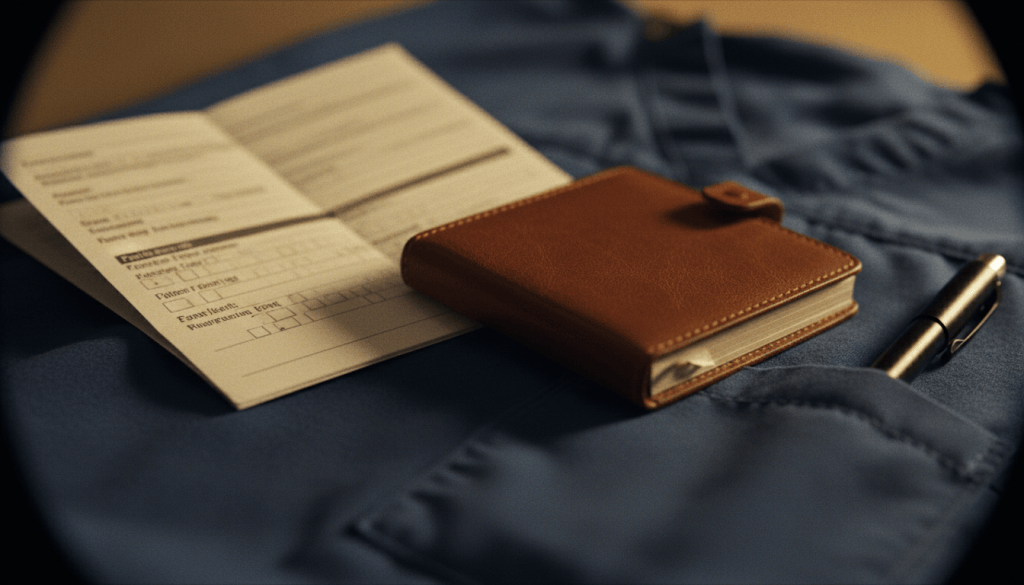
A pocket notebook can become one of the most useful tools in residency—or a chaotic graveyard of half-legible reminders that you never look at again.
The difference is whether the notebook has a job. It should not replace the medical record. It should not become a second patient chart. It should not store sensitive information that does not belong in your pocket. Its purpose is much narrower: capture what your brain should not have to hold while the shift is moving.
Give the notebook three jobs
- Tasks: what still needs to happen.
- Learning: what you need to look up later.
- Patterns: small workflow lessons worth remembering.
That is enough. If the notebook is trying to become a patient list, a textbook, a diary, a case log, and an anatomy atlas simultaneously, it stops being useful.
Keep patient information to the minimum allowed by your local policy
Privacy comes first. Follow your hospital’s rules for temporary working notes and disposal. Avoid unnecessary identifiers, diagnoses, or distinctive details. Never treat a personal notebook as a secure clinical record.
Where a temporary patient reference is permitted, use only what is necessary to complete the task and destroy or secure the working list according to local policy. Permanent learning notes should be de-identified.
Use symbols that mean actions, not decoration
A simple visual language can make the notebook fast to scan. For example, use one symbol for an unfinished task, one for something that needs senior discussion, one for a result to re-check, and one for a learning point. The exact symbols do not matter. Consistency does.
The goal is to look at the page and immediately see what remains open.
Separate work from learning
One side of a page can hold temporary tasks. Another section can hold durable learning questions:
- Why was this operation chosen?
- What anatomy did I not understand?
- What did the senior notice before I did?
- What postoperative issue came up repeatedly?
- What question should I answer before the next similar case?
At the end of the day, the temporary task section can disappear. The learning section can become tomorrow’s reading list.
Do not write everything down
Residents sometimes respond to uncertainty by taking more notes. That creates the illusion of control while slowing the actual work. Write down what you are likely to forget, not everything you hear.
If a senior gives a ten-minute explanation, capture the one question you need to revisit later. If a case teaches you one new operative concept, write one line. If a task is already safely documented in the approved team system, do not duplicate it without a reason.
End every shift with a two-minute notebook reset
- Check every unfinished task has been completed or handed over.
- Remove or dispose of temporary patient-related notes according to policy.
- Move one or two learning questions into your study system.
- Write down one workflow lesson if the day taught you something reusable.
This turns the notebook from storage into a loop: capture, act, review, clear.
What this actually looks like on a busy service
The notebook is useful precisely because residency is fragmented. You may hear an important detail during rounds, get interrupted by a page, move to theatre, then return to the ward hours later. The notebook gives the unfinished thought somewhere safe to live so you can return to it.
It is not a sign that you cannot remember enough. It is a way to stop wasting attention on remembering things that can be externalized.
Related reading: Pager Overload in Surgical Residency, Why Surgical Residency Feels Like Constant Interruption, and Before the Incision: How Residents Set an Operative Learning Goal.





Leave a Reply